Category Archives: Services

William Henry Achurch

William Henry Achurch
2nd Lieutenant 
2nd/5th Battalion Royal Warwickshire Regiment
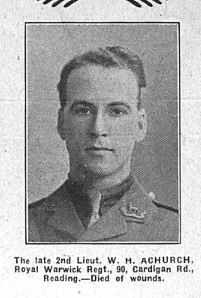
 

 ACHURCH WH

William Henry Achurch was the eldest son of Mr and Mrs Achurch, of 90 Cardigan Road, Reading.   He died of wounds received on the 6th December 1917, aged 25.  The Reading Chronicle of the 14th December 1917 carried an obituary.  The article states that he had been badly wounded in the chest.  The British launched a surprise attack at Cambrai on the 20th November 1917.  Ten days later the Germans attacked the salient and penetrated the British lines.  This was followed a few days later by a withdrawal from the area around Bourlon Wood and the eventually checking of the enemy.  The Battle of Cambrai officially ended on the 7th December 1917.  William Achurch is buried at Rocquigny-Equancourt Road British Cemetery, Manancourt, Somme, France.  Location VI. D. 14.

Rocquigny and Equancourt are two villages in the Department of the Somme, some 13 kilometres north of Peronne and 12 kilometres south-east of Bapaume. Rocquigny and Equancourt are approximately 8 kilometres apart and the Rocquigny-Equancourt British Cemetery lies about halfway between the two villages on the north side of the road just west of the crossing road from Etricourt to Ytres.  Etricourt was occupied by British troops at the beginning of April, 1917 during the German Retreat to the Hindenburg Line. It was lost on the 23rd March, 1918, and regained at the beginning of September. The cemetery was begun in 1917, and used (mainly by the 21st and 48th Casualty Clearing Stations, posted at Ytres) until March, 1918.

William Achurch joined the Yeomanry soon after the outbreak of war.  He was transferred to the Worcesters, promoted to the rank of Sergeant whilst on the Somme.  Later he was commissioned to the Royal Warwickshire Regiment, returning to England to train in Oxford.  He had been back at the front for four months when he was killed. He had seen a great deal of fighting.

William Achurch was a member of Wycliffe Chapel, a Sunday School teacher and Scout Master.  Before the war he worked for Messrs. Sutton and Sons.
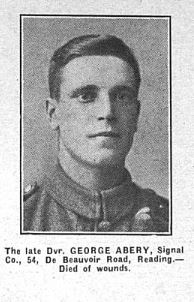
George Abery

George Abery
Driver 69183
35th Signal Company Royal Engineers

ABERY G

George had seen twenty three months of active service when he died of wounds on November 29th 1917, he was nineteen years old.  His unit was the 35th Signal Company of the Royal Engineers.  This unit was raised in Reading and was held in high esteem by the town.  George was the son of Mr and Mrs W. Abery of 54, De Beauvoir Road, Reading.  He is buried in Dozinghem Military Cemetery, Westvleteren, Poperinge West-Vlaanderen Belgium.  Grave XV. E. 12. 

Poperinge was used by troops for rest and relaxation from the Ypres battle front.  Casualties from the front would pass through the area on the way to trains and home to “Blighty”.  Dozinghem was one of a trio of cemeteries, the other two being Bandagem and Mendingham, named by British troops to  sound like local Flemish names, which served the casualty clearing stations and field hospitals around Proven which was the British Army rail centre.  We do not know exactly the extent of the wounds George received but about the time he was injured one of the worst battles of the whole war was taking place at Passchendaele.  For over three years, the Germans held the ridge, until, on November 6th 1917, the rubble which had once been the village was captured by the Canadian Corps.   Many of his colleagues from the school were less lucky and had no known graves, instead they are commemorated on the walls of the Tyne Cot Memorial to the missing on Passchendaele ridge which is on the site of the largest Commonwealth Military cemetery any where in the world, Tyne Cot British Military Cemetery.

Serjeant R. John Brill

Sergeant. R. John Brill
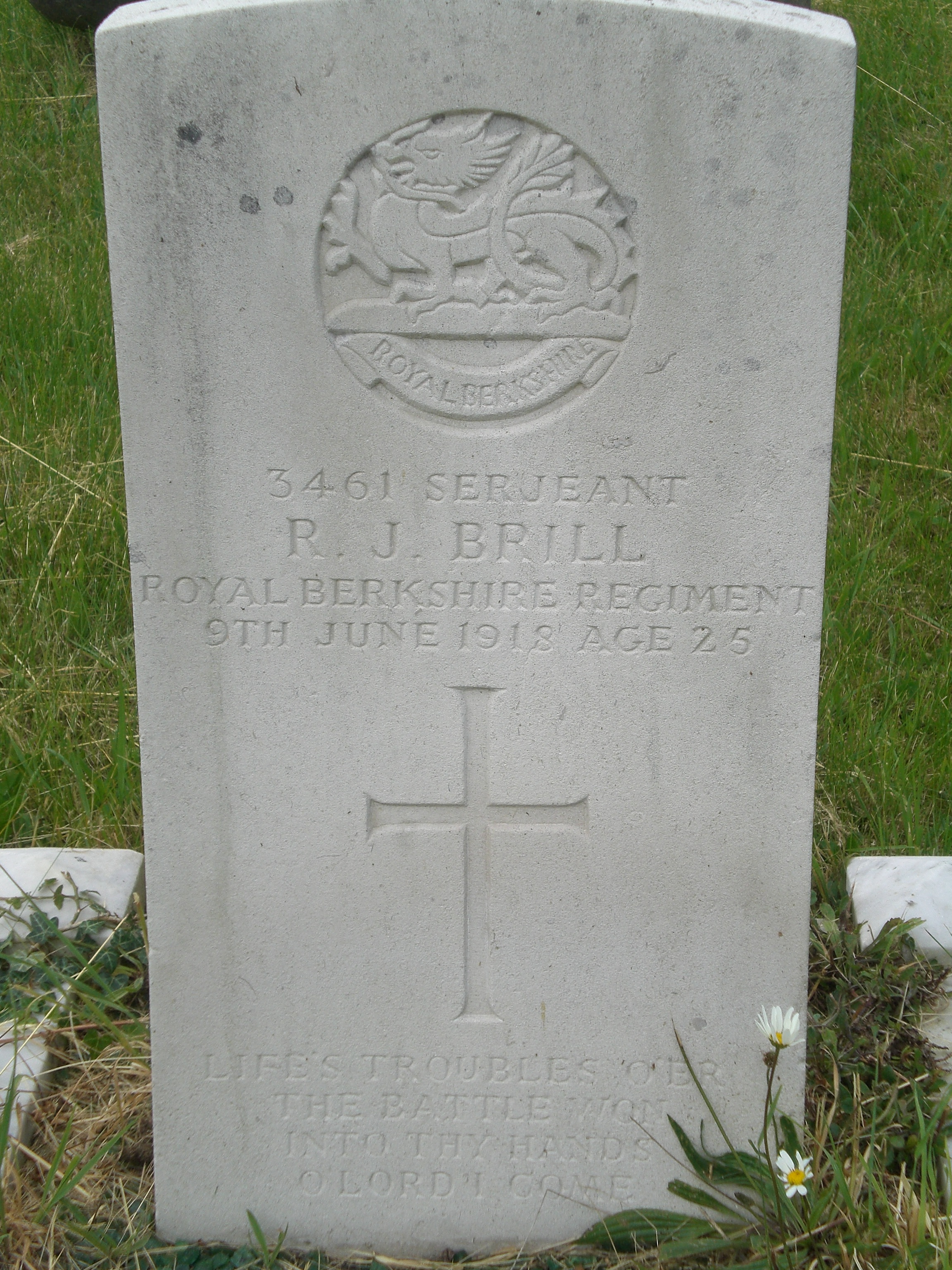
3461 2nd/4th Royal Berkshire Regt.
transferred to (224543) 251st Div.,
Employment Coy., Labour Corps. 

Division 17 

 BRILL RJ  CIMG2189


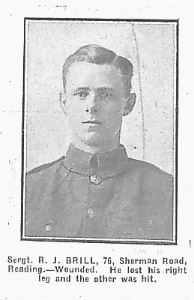
 John Brill, was the son of Frederick William and Ruth Brill, 76, Sherman Road, Reading.   He died 9th June 1918 of wounds received on March 21st 1918, aged 25 years.   His parents may have referred to him as “Reg”.  A relation, Jan Brown,  who has contacted the site states that his name was actually Reginald Jessie Brill.

Sergeant Brill was wounded in action loosing his right leg, the other was also hit.   A native of Reading R J  Brill joined up when war started, prior to this he worked for Messers. Bradley and Bliss.  He saw over two years service in France.  Educated at St. Giles school and the Bluecoat School.  An active member of the A.O.F., being associated with  the Court of Sherwood Forest and was a member of the Spring Garden (Prize) Band.  He was buried with full military honours.

 The grave number is 17. 3555 and is marked with a CWGC war pattern headstone and kerb stone surrounds. 

Sergeant Brill had two brothers.  They are not commemorated on his grave but information about them was obtained from the newspapers of the time.

BRILL AV

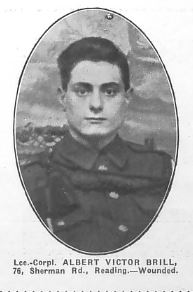
 L.Corpl., 15256, Albert Victor Brill had been employed by Phoenix insurance prior to the war.  He eventually reached the rank of Company Quarter Master Sergeant.  He  survived the war to later marry and have two sons.  He was wounded at least three times, once during the Battle of Loos. He died in 1949.

BRILL WALTER

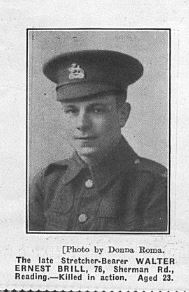
 Pte. 12854, Walter Ernest Brill, the 3rd son, was a stretcher bearer in 6th Royal Berkshire Regt.  He was killed in Action  19th July 1916  Aged 23 years.  A  letter from an officer was published in the Reading Standard September 2nd 1916

 “I cannot tell you exactly where your son met his death.  He was engaged in carrying a wounded man to the rear when a shell struck the stretcher and your son was killed instantly.  I can vouch for this, as he was seen by a runner who was afterwards wounded, and I received the news from several men in the company that it occurred on July 19th in _____Wood.  No one in the magnificent battalion did better than he as a stretcher-bearer.  You have my sincerest regrets for the loss of your boy”.

The death of Frederick William Brill (father of the Brill boys) after a short illness – aged 54 years, was notified in the Reading Standard September 27th 1919. William Brill had worked in the Huntley and Palmers Biscuit Factory. In the 1911 census return, he described his occupation as “Biscuit factory shooting off biscuits”!