Category Archives: Ypres

William Walter Love & Leonard Noble Love

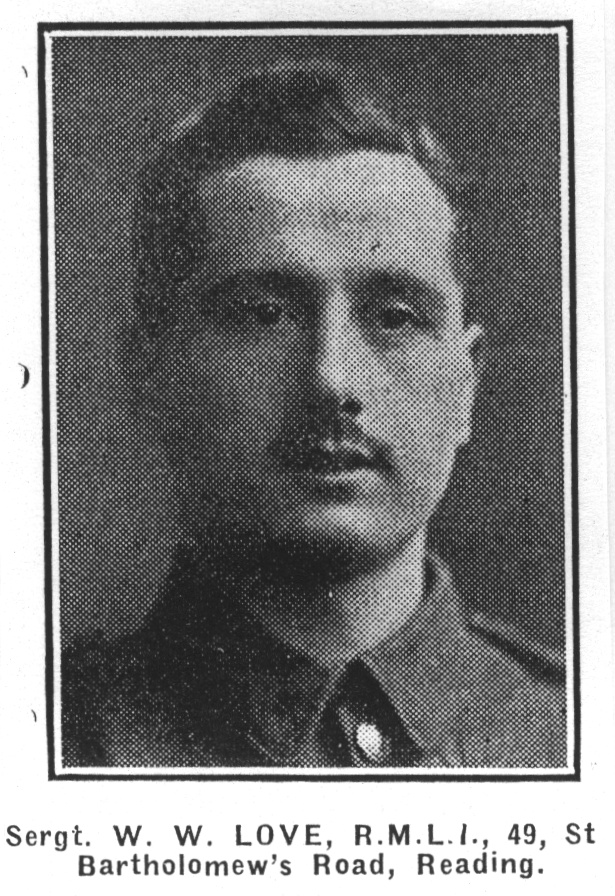
William Walter Love M.M.
Sergeant -Major Royal Marine Light Infantry
Royal Naval Division

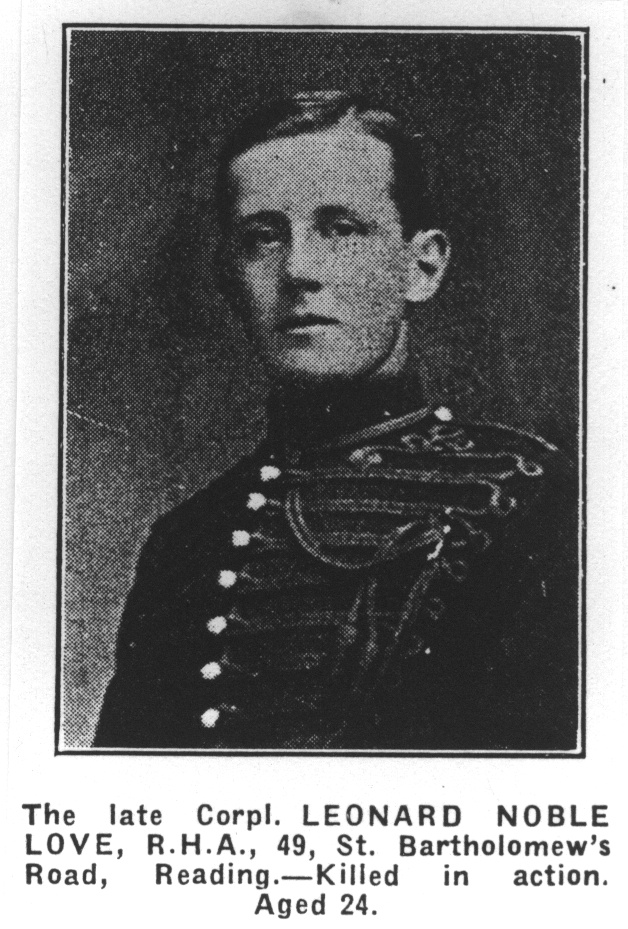
Leonard Noble Love
Corporal 52805
“B” Battery Royal Horse Artillery

Division 52
Love WW photo Love LN photo

William Walter Love and Leonard Noble Love are commemorated on the grave of their parents, Mary and William Robert Love and also on the St. Bartholomew’s Church memorial.   At the time of their deaths the Love family were living at 49, St. Bartholomew’s Rd. Reading.   The 1901 census indicates that Mr William R. Love, aged 39, was already a widower. William Love’s  widowed mother and sister were living with the family which comprised five children, four boys and one girl at 12, Mancherst Road. WilliamR Love was a carpenter and joiner by trade.

William Walter Love  was described in the 1911 census as a bicycle engineer. He was killed in action on Oct. 26th 1917 aged 23.  He was the third son of Mr. W.R. Love. He had served with the Royal Naval Division throughout the Gallipoli campaign. His death was reported in the Standard November 17th 1917.

The 26th October 1917 marked the beginning of the Second Battle of Passchendaele.  The German front line was hit with shell fire along its length for four days preceding the start of the battle.  Due to the naturally high water table and broken dykes the battlefield was largely a sea of mud.  The Royal Naval Division attacked on the left hand side of the Canadians who were attacking Bellevue Ridge, they gained some ground but with heavy losses.  It is probable that William Walter Love was amongst them.  Serjeant Major Love has no known grave and is commemorated on the Tyne Cot Memorial Panel 1 and 162A.

It has not been possible to find the citation for his Military Medal.

Leonard Noble Love was the second son of Mr. Love.  Leonard served 6 years (8 years in one report) in the regular army. The 1911 census indicates that Leonard Noble Love was born in 1891 and was then aged 20. He was in Z Battery RHA. He was serving in Egypt,Sierra Leone, South Africa and Sudan.

Leonard Noble Love was mentioned in dispatches in Sir Charles Monroe’s Gallipoli dispatch.  A report in the Chronicle 2nd July 1915 was an extract from a letter sent to his father on 11th May 1915.

“I am writing this in a trench with the rain pouring down, hoping that it will soon cease, as it is not very comfortable.  We have been in action since 27th April.  Our troops are making progress in the right direction.  We had rather a big night attack on the 1st May, but things ended up alright in the finish.  Since then we have advanced.  We get very good rations, and plenty of them, which is a great thing, as one always feels better after a good meal.  I am glad to say that the rain did not last long this morning; the weather is perfect.  Things are rather quiet this morning , and have been so for the last two or three days.  There is the usual spasmodic burst of shrapnel and rifle fire.

“I have seen one of the most thrilling sights of my life -that was the bombardment of the forts by the Navy.  For about three days it was like a tremendous thunderstorm.  Buildings were changed into heaps of dust, big guns were dislodged from their mountings, and, to sum up the whole thing, the Turks were ‘none too happy.’   It is a great thing to see the way our infantry behave, and to see them charge is a great sight.

“ I got in rather a tight corner on the night of the 1st May but managed to scrape through all right.  While I am writing there is a howitzer battery engaging a turkish battery, and what I can see they are smashing it up.”

Unfortunately he was killed in action on January  6th 1916,  the day before the last of the army was finally evacuated from Gallipoli. (Chronicle July 21st 1916)  He also has no known grave and is commemorated on the Helles Memorial Panel 21 and 22.

Mr. Love’s youngest son Lance Corporal Fred Love enlisted  with the Royal Berkshire Regiment served in France from March 1915.
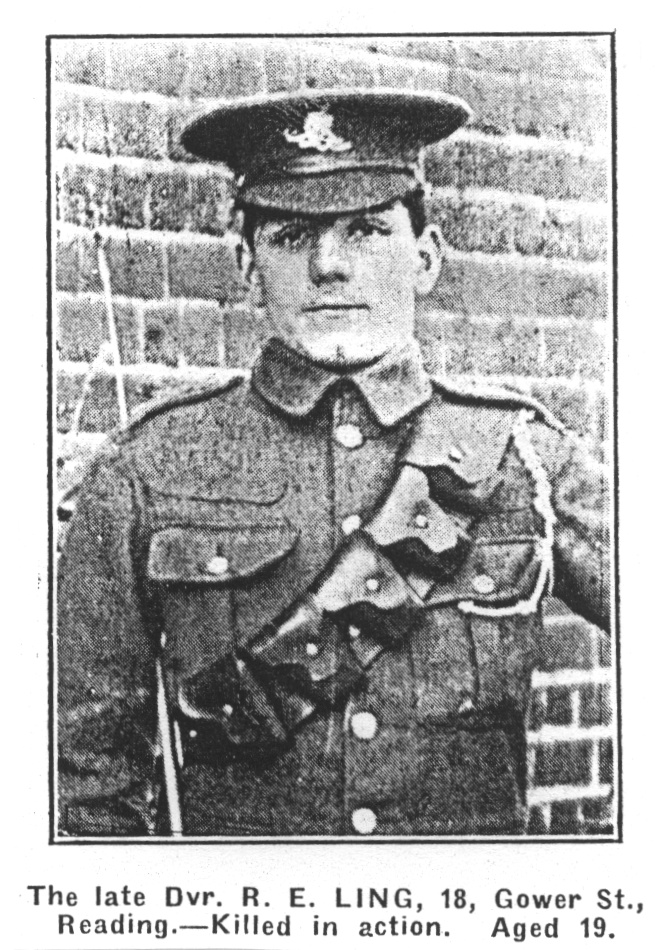
 

Robert Ernest Ling

Robert Ernest  Ling
Driver 79361
103rd Battery Royal Field Artillery

Division 14

Ling RE photo

Robert Ernest Ling  was the son of Mrs L. Ling, (later Mrs Brown) of 18 Gower Street, Reading.  He is remembered on her grave.

Before the war he was employed by Mr. H. J. Blundell, grocer and confectioner of Oxford Road.  He was a member of the St. James Catholic Church and the Reading Catholic Club connected with it. He was 19 years old and the first member of the club to fall in battle.   The Rev. Father Kernan referred to his death in a Sunday service and while sympathising with his mother “in the great loss she had sustained, also congratulated her upon the fact that her son had died fighting for his country”. 

Robert Ling was killed on February 24th 1915.  When initially reported in the papers it was stated “somewhere in France”, but his commemoration on the family grave states killed at Ypres. He is buried in Ypres Town Cemetery Extension, Menin Gate. Grave I. F. 1.

William Lewington & Francis James Lewington

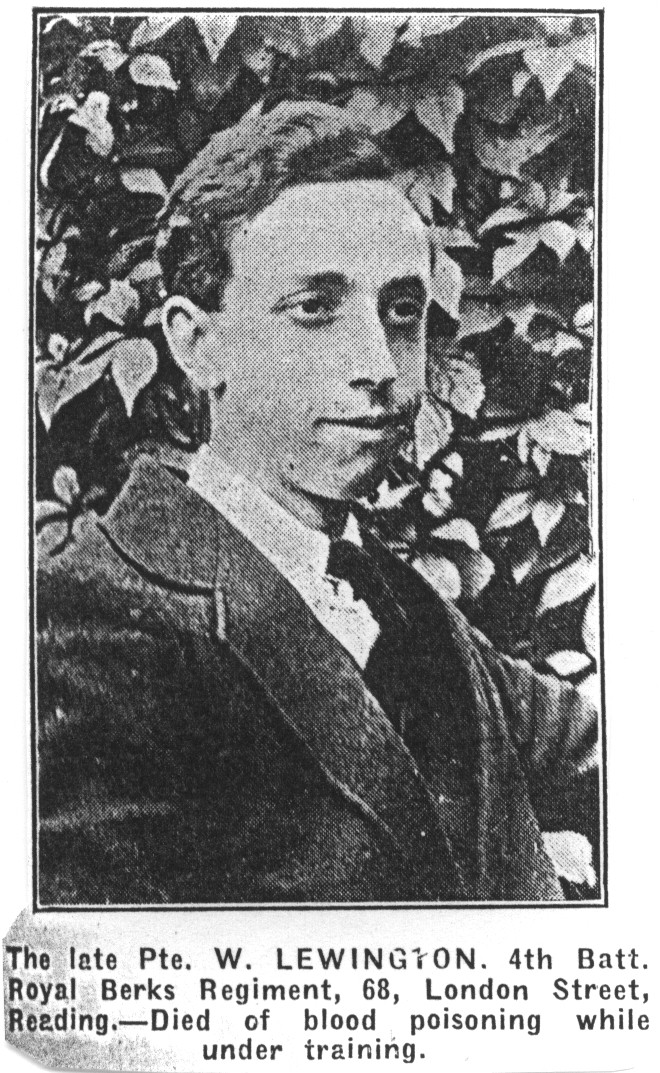
William Lewington
Private 2973
4th Battalion Royal Berkshire Regiment.

Division 29

 W Lewington photo F Lewington Photo

Private W. Lewington was twenty years of age (a report in the Reading Standard 14th November 1914 states 19 years).  He died, in Maidenhead hospital, after a short but painful illness according to the report.  The caption of the photograph states that this was blood poisoning. William Lewington was  in training at the time.  An article in the Reading Chronicle 15th January 1915, quoted on the next page, stated that a beam had fallen on his hip.

William was the second adopted son of Mr W.J.Giles of  68 London Street, Reading. As “Wilton the Magician” William was a favourite performer at local amateur and benefit concerts.

He was given a military funeral and his  burial was the first of the WW1 burials.  He shares his grave with his cousin.

Francis James Lewington
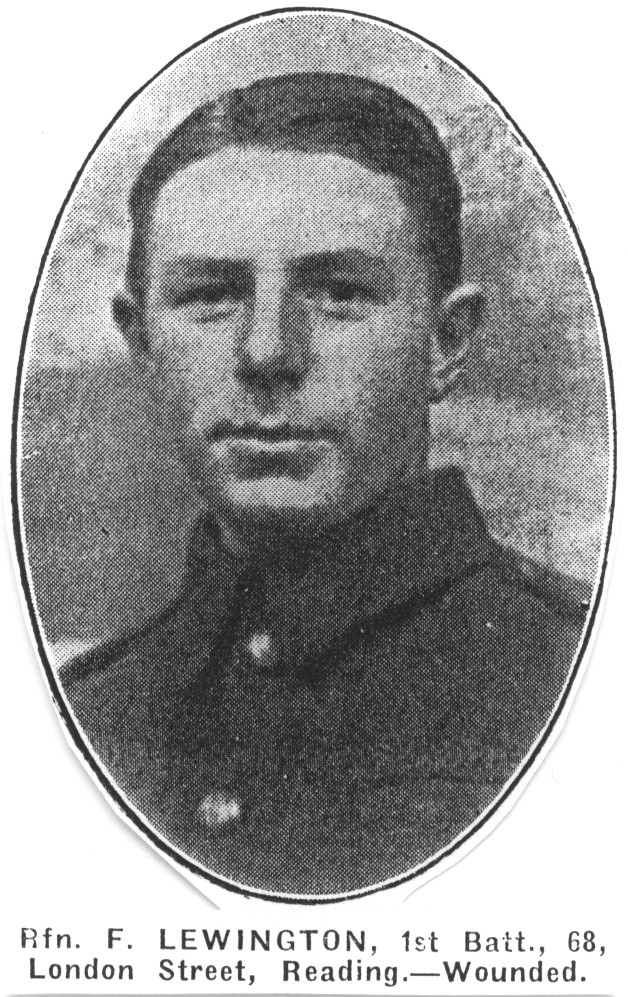
Rifleman 11397
1st Battalion King’s Royal Rifle Corps. 

Francis James Lewington was an ex-employee of the  “Chronicle” and then served in the regular army  going to France with the BEF in August 1914.  He was wounded in the left shoulder whilst fighting at Ypres early in January 1915 and invalided home with the bullet wound.  A  letter about his experiences around and was published in the Chronicle on January 15th 1915 in  which he outlined his experiences.

       “ I went out on August 12, and one of the first sights I saw was a church burning at Ladmark.  [sic] (Langemark authors note)  For 21 days we were in trenches at Soissons, but we made a charge, on which occasion I received a bullet wound before going very far.  It was a clean-cut wound.  I had a good time on board the hospital ship coming home.  The bullet was not extracted for a week, when it was removed by a sister at Tidworth. 

“On September 13 our brigade captured about 300 Germans.  They surrendered under the white flag, but while those in front were surrendering, they were fired on by their fellow countrymen behind, the latter making off.

“While we were in trenches near Super (?) a sad fate befell a company of Cameronians.  They were in a cave, but the Germans shelled it, and buried nearly the whole of them.  For several nights afterwards their comrades were removing dead bodies.

“The 1st Berks have fought splendidly.

“We take a great deal of interest in football, and I was very pleased with Reading’s run.

The article also refers to the death of his cousin William Lewington, and that he had two more cousins at the front with 2nd  Royal Berks.; they had previously served in India.

On Nov. 13th 1916 he was wounded in the back and  ultimately  died at Leeds on Dec. 13th 1916.   A newspaper of the time when reporting his death states – ” The blow is all the more severe to his mother by the fact that he wrote cheerfully home the day before he died to say that an operation to extricate several bullets from the region of his spine was successful.  A change for the worse, however, soon became apparent, and death occurred within a few hours”. 

Francis James Lewington  was 21and the only son of Mrs Lewington   His was a full military funeral attended by members of his family and regiment, a Bugler  played “The Last Post”.