Category Archives: Ypres

Thomas Henry Palmer

Thomas Henry Palmer
Private 9829
1st Battalion Dorsetshire Regiment

 Division 12
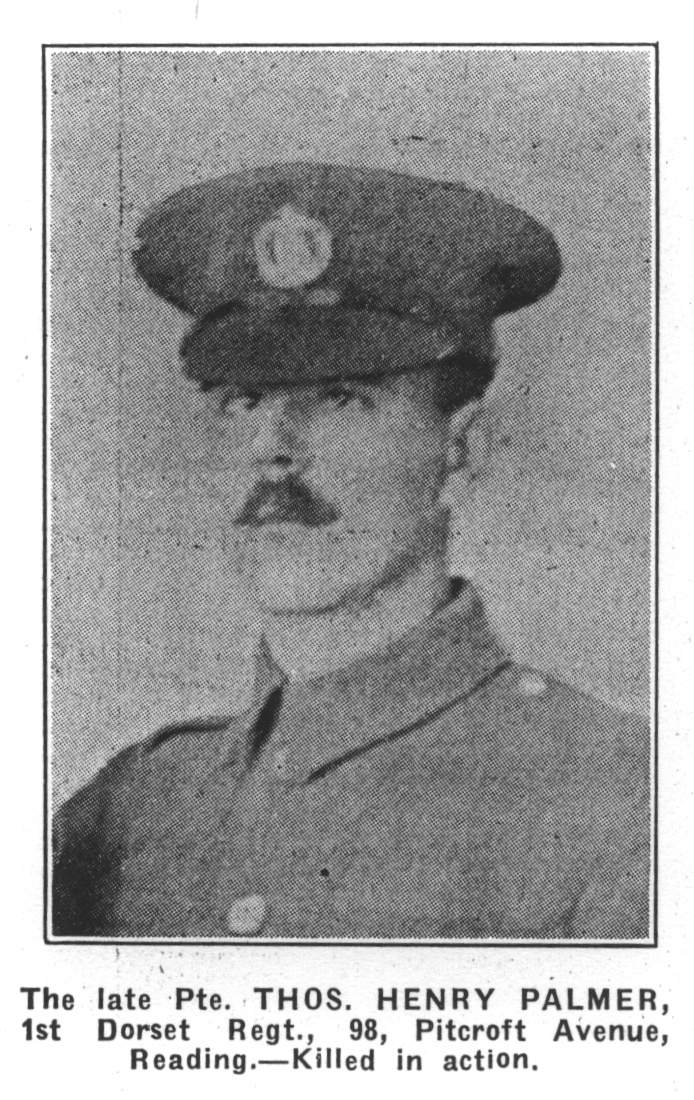
Palmer TH photo

Thomas Henry Palmer’s home address was 98, Pitcroft Avenue, Reading.  He is commemorated on a his family’s grave. His father was James Palmer, a railway clerk and his mother Rosalind Palmer. The 1911 census indicates that Rosalind had borne nine children although only four servived. A daughter Rosalind May Keys, her husband Herbert and son Charles were living with the Palmer family. Thomas’s two sisters Alice and Bessie were also living in the family home.  Thomas enlisted on 27July 1914, some days before the official declaration of war. Perhaphs with the intention of making acareer change. He was almost 24 years old. He  joined the Dorset Regiment on 7 August and he was posted on active service  overseas in October 1914.  His service record on Ancestry UK indicates that his occupation was that of a fitter and turner.  Thomas had served in the 1st/4th Royal Berkshire Regiment  (Territorial Force) before the enlisting in the Dorset Regiment. His mother Rosilind is given as his nextof kin in the service record and it was she who received his medals and personal effects upon his death. Thomas Palmer was killed in action on the 26th April 1915.  He  is buried at White House Cemetery, St. Jean-les-Ypres, location IV. A.42. 

Although the commemoration on the kerbs states killed in action in France, Thomas is actually buried in Belgium.  The “White House” was on the Ypres road, between St. Jean and the bridge over the Bellewaardbeek.  The cemetery was begun in March, 1915, and used until April, 1918, by units holding this part of the line.  Originally it contained Plots I and II; but after the Armistice these Plots were completed, and III and IV added, by the concentration of graves from the battlefields round Ypres and from smaller burial grounds.   Thomas Palmer’s service record states that he died from the effects of a gunshot wound. It is probable that his body was brought to  the White House Cemetery from a smaller burial ground belonging to a casualty clearing station after the Armistice .

 The Second Battle of Ypres had begun on 22nd April 1915.  The Germans used poison gas for the first time during the next week.  On 26th April the British launched counter attacks against the Germans south-east of Pilckem and towards St. Julien.  The efforts came to naught with the British incurring 4,000 casualties during the day as they faced the superior German machine guns and artillery.  Thomas Palmer is believed to have been a casualty of the fighting which took place in the area.
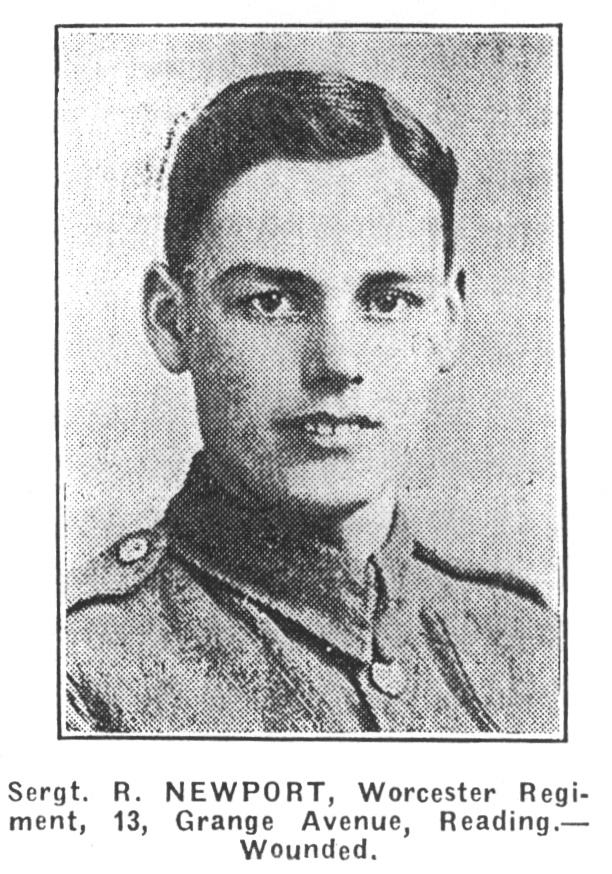
Reginald Newport

Reginald Newport
Signaller 20221
3rd (later 7th) Battalion Worcester Regiment

Newport R photo Newport R name

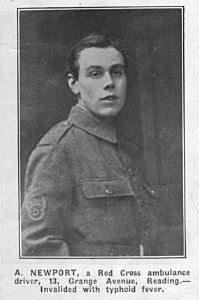
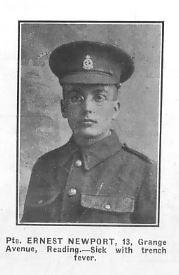
Reginald Newport was the son of Tom and Caroline Newport, of 13 Grange Avenue.  The 1911 census indicates that he had two older brothers Albert and Ernest and an uncle Henry living in the family home. Father Tom was recorded as a wood saw sharpener at a timber merchants, Henry was a carpenter, brother Albert an apprentice to a motor engineer and Ernest a plumbers assistant. Reginald then 13 was still at school. Pictures of the brothers has been obtained from Berkshire and the War but it has not been possible to find any further details about their military service.

 NEWPORT A NEWPORT ERNEST

Reginald was last seen on 26th April 1918 and was reported missing.  Parents were often desperate to find out where and how their sons had died and frequently had requests for information published in the papers.  Reginald Newport’s  mother was still seeking information about his end in a brief article published in the Standard October 18th 1919, his picture was published on page 7 of the same paper:

 “203221 Sig. R. Newport – 7th Worcestershire Regt. Reported missing on April 26th 1918, now assumed to be dead.  If any returned soldier knows anything concerning his end, would they kindly communicate with Mrs. Newport 13 Grange Avenue.”

In March 1918 the Germans began what was known as the “Spring Offensive”.  Beginning with a long bombardment and using specially trained storm troopers the attack began with increasingly ferocious trench raids followed by Operation Michael which was aimed at the junction between the French and British Armies on the Somme.  This was followed by Operation Georgette, along the River Lys.  By 11th April Armentieres was evacuated and Haig issued this famous speech to his men “…..Every position must be held to the last man: there must be no retirement.  With our backs to the wall….each one of us must fight to the end.”   On the 15th April the bloodily won ridge of Passchendaele was evacuated and the British divisions withdrew to a line around Ypres which approximated to that of 1915.  The British were below full complement and the new men, replacing those lost in Third Ypres, were young and incompletely trained, although they fought bravely.  On the 20th April there was a massive gas bombardment of the British line followed up by a further bombardment on the French on the 25th April.  The Germans moved seven divisions forward and the British fell back to Dickebusch Lake.  Whilst the French took the major force of the attack the British eventually were able to hold their positions.  On the 29th April the Germans renewed their attack but it failed.  The Second Battle of Lys was over.  Losses were heavy 76,300 British and 35,000 French.  (German casualties amounted to 109,300).  Among the British losses was Reginald Newport.

Reginald Newport has no known grave and his name is commemorated on the Tyne Cot Memorial to the Missing panels 75/77. Reginald Newport died aged 20 years.

William James Mundy

William James Mundy
Private G/9171
11th Battalion Queen’s Own (Royal West Surrey Regiment)

  Division 35

Mundy WJ photo


William James Mundy was the son of Mrs E. E. Mundy, of 28, Henry Street, Reading. His father H. Mundy was already dead at the time of his son’s death.  He was commemorated on a his family’s grave.  The 1911 census indicates that William was working as a barman at a hotel in Aldershot. William died on the 31st July 1917, the first day of the Third Battle of Ypres.

The Third Battle of Ypres began on 31st July 1917.  A bombardment had begun fifteen days earlier and over four million shells had been fired.  (One million had been fired prior to the Battle of the Somme).  At 3.50a.m. the assaulting troops of the Second and Fifth Armies, with a portion of the French First Army lending support on the left, moved forward, accompanied by 136 tanks.  The Tank Corps was only four days old.  Previously it had been known as the Heavy Branch, Machine Gun Corps, a name adopted for purposes of secrecy at their formation.  Preparations for the battle had taken place in dry weather but on the first day the weather broke and three-quarters of an inch (21.7mm) of rain soaked the battlefield.  Men and tanks moved forward behind the creeping barrage over ground churned and cratered by years of shelling.  The surface was softened by the rain but, for all that only two tanks bogged down at the commencement of battle although many ditched later.  A map was prepared by Major Fuller, Staff Intelligence Officer of the Tanks, of the ground over which the tanks were expected to attack.   Where he expected the ground to be marshy, he coloured the area blue.  What he saw appalled him, it was three-quarters of the battlefield.  He sent the maps to Haig’s GHQ so that the Commander in Chief could judge conditions for himself.  However, the map was intercepted by Charteris who refused to show it to the Commander in Chief on the grounds that it would depress him.  Only 48% of the tanks reached their first objective.  Although there was some progress in the early part of the day by late morning the familiar breakdown in communications between infantry and guns occurred.  At two in the afternoon the Germans began to counter attack with a heavy shelling and this together with the heavy rain turned the battle field into soupy mud.  A halt to the offensive was called until the 4th August.  However, Haig insisted that the attack had been “highly satisfactory and the losses slight”.  By comparison with the Somme, when 20,000 men had died on the opening day, only about 8,800 men were reported dead or missing.  The total wounded, including those of the French Army, numbered 35,000, the Germans suffered a similar number.  However, the Germans remained in command of the vital ground and committed none of their counter attack divisions.  Prince Rupprecht , in his diary recorded that he was “very satisfied with the results”.

It is not known exactly when and where William Mundy  was killed, he has no known grave and his name is commemorated on the Menin Gate Memorial, Panels 45 & 47.  He was aged 25.