Category Archives: Ypres

Rudolph Ellis Davies

Rudolph Ellis Davies
Lieutenant 1st/7th Battalion Duke of Wellington’s
(West Riding Regiment)

 Division 15

Rudolph Ellis Davies was the son of Baptist Minister Reverend A. J. Davies and Mrs K Davies.  At the time of CWGC registration Mrs Davies address is given as 29, Montague Road, Cambridge.  Rudolph is remembered on the grave that bears both the name of his sister Gwen, who died aged 19, September 29th 1905 and the Reverend Davies who died on May 19th 1916, aged 55. 

 Rudolph Davies died on 11th August 1917, aged 27, during the very heavy fighting of the battle of 3rd Ypres. It is not known exactly when Rudolph Davies received the wounds that caused his death.  The 11th August was the day the Germans launched a heavy counter attack and pressed the British line back in Glencorse Wood. 

 Davies is buried in Adinkerke Military Cemetery, De Panne, West- Vlaanderen, Belgium.  Location G. 3.  Adinkerke was an area that hosted two major Casualty Clearing Stations serving the British XV Corps that held the front from the Belgium coast to St Georges.
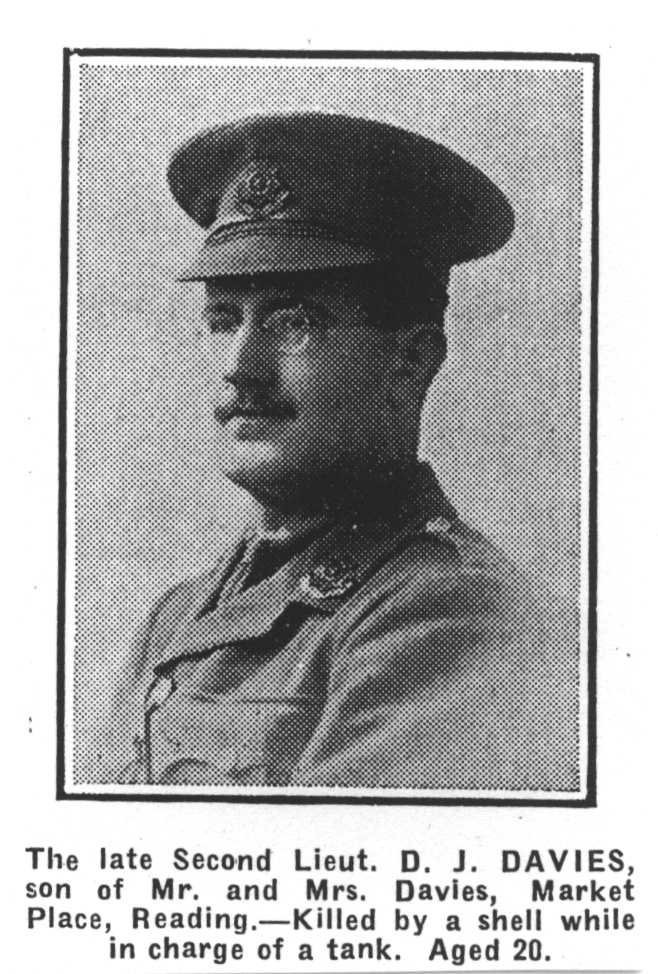
David James Davies

David James Davies
Second Lieutenant
Machine Gun Corps attached to “C” Battalion Tank Corps
.

Division 13

Davies DJ photo

David James Davies was the son of Mr Walter and Mrs Florence Esther Davies of 32. Market Place, Reading.  It was from that address that Walter Davies ran his shop selling china and glass. In 1911 David was 13 and still at school. HIs older sister Ester Madeline is described as working part time in the shop and part time as a student. David’s oldest sister Florence was not living with the family in 1911.  He was commemorated on a his family’s grave. 

 The Third Battle of Ypres began on 31st July 1917.  A bombardment had begun fifteen days earlier and over four million shells had been fired.  (One million had been fired prior to the Battle of the Somme).  At 3.50a.m. the assaulting troops of the Second and Fifth Armies, with a portion of the French First Army lending support on the left, moved forward, accompanied by 136 tanks.  The Tank Corps was only four days old.  Previously it had been known as the Heavy Branch, Machine Gun Corps, a name adopted for purposes of secrecy at their formation.  Preparations for the battle had taken place in dry weather but on the first day the weather broke and three-quarters of an inch (21.7mm) of rain soaked the battlefield.  Men and tanks moved forward behind the creeping barrage over ground churned and cratered by years of shelling.  The surface was softened by the rain but, for all that only two tanks bogged down at the commencement of battle although many ditched later.  A map was prepared by Major Fuller, Staff Intelligence Officer of the Tanks, of the ground over which the tanks were expected to attack.   Where he expected the ground to be marshy, he coloured the area blue.  What he saw appalled him, it was three-quarters of the battlefield.  He sent the maps to Haig’s GHQ so that the Commander in Chief could judge conditions for himself.  However, the map was intercepted by Charteris who refused to show it to the Commander in Chief on the grounds that it would depress him.  Only 48% of the tanks reached their first objective.  Although there was some progress in the early part of the day by late morning the familiar breakdown in communications between infantry and guns occurred.  At two in the afternoon the Germans began to counter attack with a heavy shelling and this together with the heavy rain turned the battle field into soupy mud.  A halt to the offensive was called until the 4th August.  However, Haig insisted that the attack had been “highly satisfactory and the losses slight”.  By comparison with the Somme, when 20,000 men had died on the opening day, only about 8,800 men were reported dead or missing.  The total wounded, including those of the French Army, numbered 35,000, the Germans suffered a similar number.  However, the Germans remained in command of the vital ground and committed none of their counter attack divisions.  Prince Rupprecht , in his diary recorded that he was “very satisfied with the results”.

 It is not known exactly when and where David James Davies was killed in command of his tank but it was struck by a shell on the opening day of the battle.  David Davies had no known grave and his name is commemorated on the Menin Gate Memorial, Panel 56.  He was aged 20.

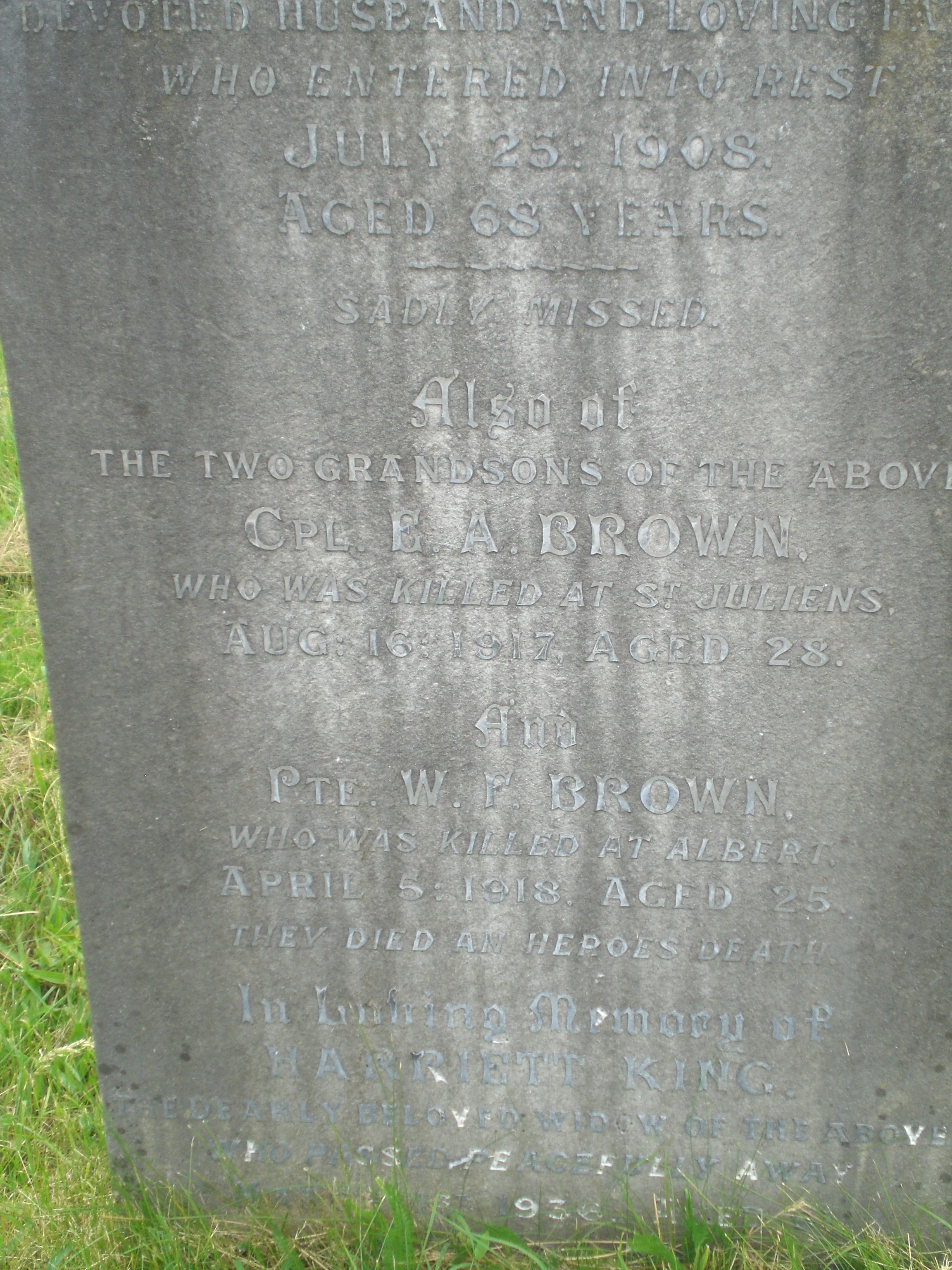
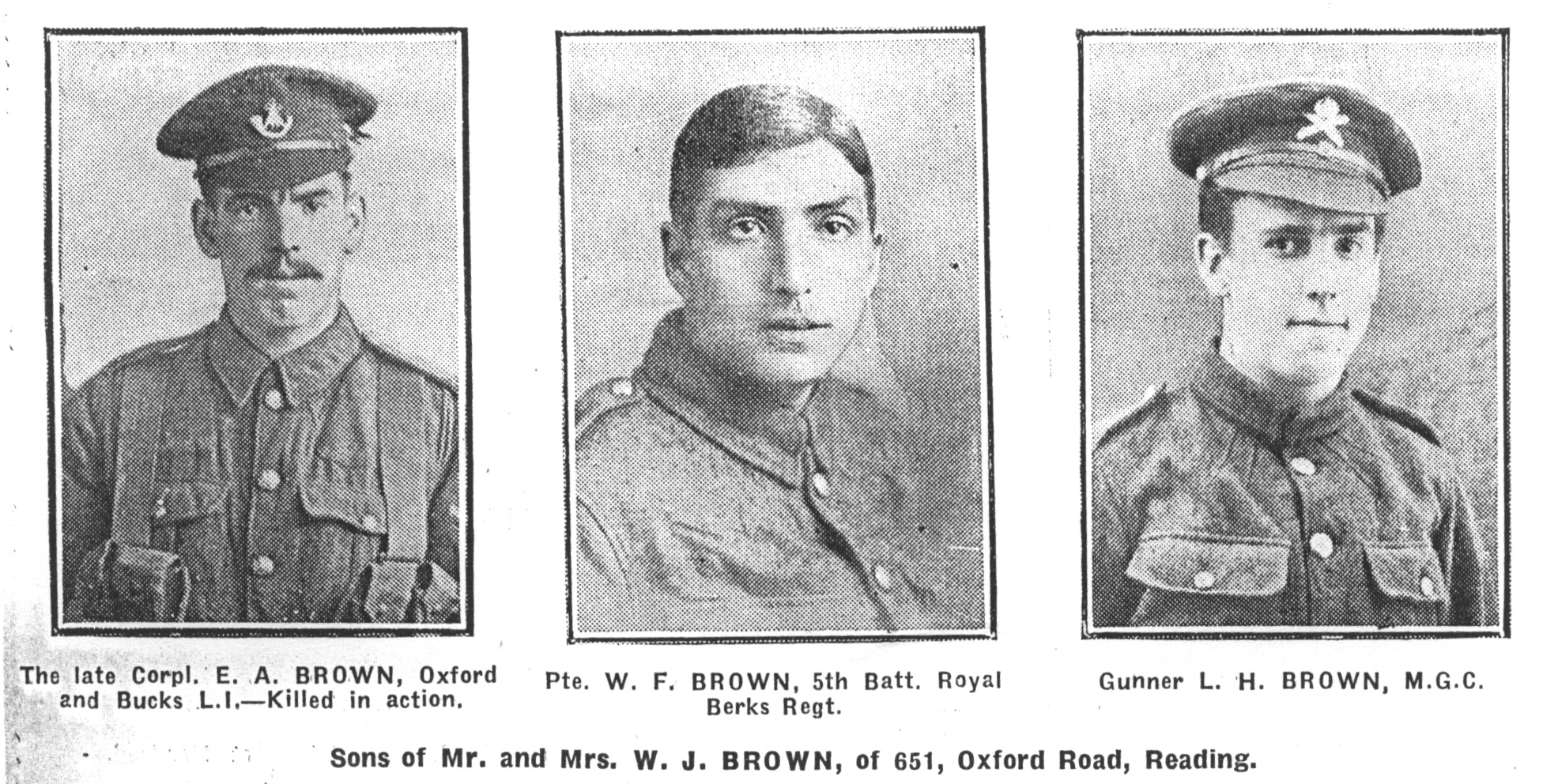
Ernest A Brown and William Frederick Brown

Ernest A. Brown
Corporal 203874
2nd Battalion Oxford & Bucks. Light Infantry

William Frederick Brown
Private 201425
5th Battalion Royal Berkshire Regt.

 Division 15

 Brown EA and WF photo

 Ernest and William Brown are pictured with their brother in Berkshire and The War.  Gunner L. H. Brown, served with the Machine Gun Corps.,  he probably survived the war.  Ernest and Frederick are commemorated on the headstone of the grave of their grandfather.  They were the sons of William J. and Ellen Brown, 651, Oxford Rd. Reading. 

CIMG2187


 The Standard September 15th 1917 printed the notification of the death of Ernest Brown. He was killed  during the 3rd Battle of Ypres.

“In everlasting memory of my dear husband, Corporal. E. A. Brown, Oxford and Bucks. Light Infantry killed in action August 16th 1917.”   

 Oh, how I longed to see him
After victory won,
But God thought it best to take him
Before the fight was won.
Sleep on dear Ern, in your lonely grave,
A grave I may never see,
But as long as life and memory last
I will remember thee.” 

Ernest Brown is buried in New Irish Farm Cemetery, Location XI.F.13.

 Frederick’s wife Francis Violet Brown posted the notification of his death.  Her address was given as 31 Manchester Rd., Reading.   Frederick was killed in action, on the 5th April 1918.  His death occurred  during the Battle of Albert, he was aged 28.  At the time the British were being driven back by the Germans who had launched their major offensive in the spring. 

No loving friends stood round his bed,
No loving mother closed his eyes,
No roof above his brave young head,
Only France’s cloudy skies;
No bell to toll the mournful tale,
With sad but kindly tone,
But we know he’s gone to a better vale,
His Heavenly Father’s throne.

 William Brown has no known grave and is commemorated on the Pozieres Memorial Panel 56 & 57.