Category Archives: Western Front

Norman Bradby Bloomfield

Norman Bradby Bloomfield
Private 440296
5th Battalion
Saskatchewan Regt.
Canadian Expeditionary Force.

Division 29
Bloomfield NB photo CIMG2103

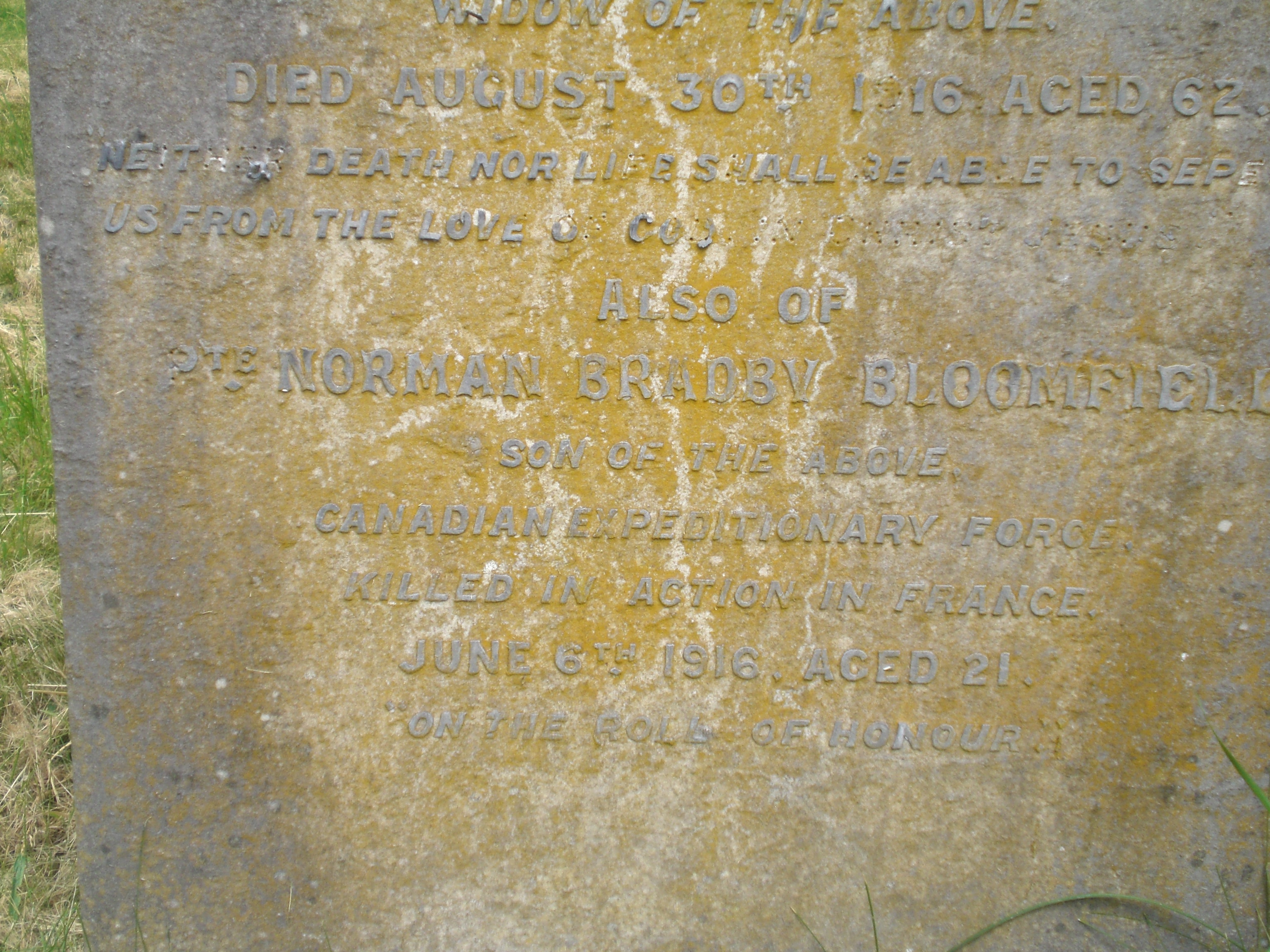
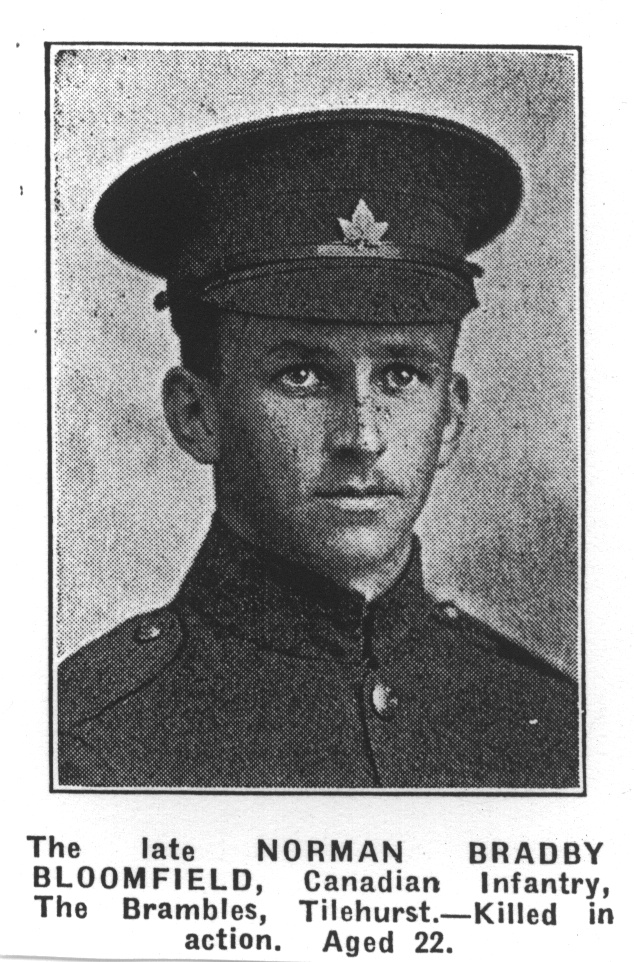
 Norman Bradby Bloomfield  was the youngest son of Charles Joseph Fulcher Bloomfield and Lucy Mary Bloomfield of “The Brambles,” Tilehurst.  He was killed in action on June 6th 1916, and is commemorated on the Menin Gate Memorial to the Missing, Panels 18-26-28.  

The Standard of 24th June 1916 reports that Norman Bradby Bloomfield “had been in Canada for some years and enlisted after the outbreak of war, coming to Europe with the Canadians a year ago. (1915)  He had been in the France* a few months and was in action in which the overseas contingent lost heavily, a shell causing instant death.”  

The Battle for Mount Sorrel took place in June 1916 beginning on the 2nd June 1916, with two German attacks.  The second attack penetrated British lines for 300 yards along a 3000 yard front, towards Zillebeke.  The Canadians were badly damaged in the area around Mount Sorrel and Hill 62.   The advance was checked at Maple Copse.  There was a failed Canadian counter attack which was followed up by a massive artillery bombardment of German positions.  Then on the afternoon of the 6th June the German’s exploded four mines at Hooge and gained some ground.  Fierce fighting continued and it was not until the 13th June that the Canadians retook the positions lost on the 2nd June.  The Canadians suffered just under 8,500 casualties; of those 1,000 men were killed and another 1,900 were missing.  Norman Bradby Bloomfield’s unit was engaged in this action although the exact details have not been researched.  There is a Canadian Memorial at Hill 62, Sanctuary Wood, Zillebeke, Belgium.

  * For France read Belgium. 
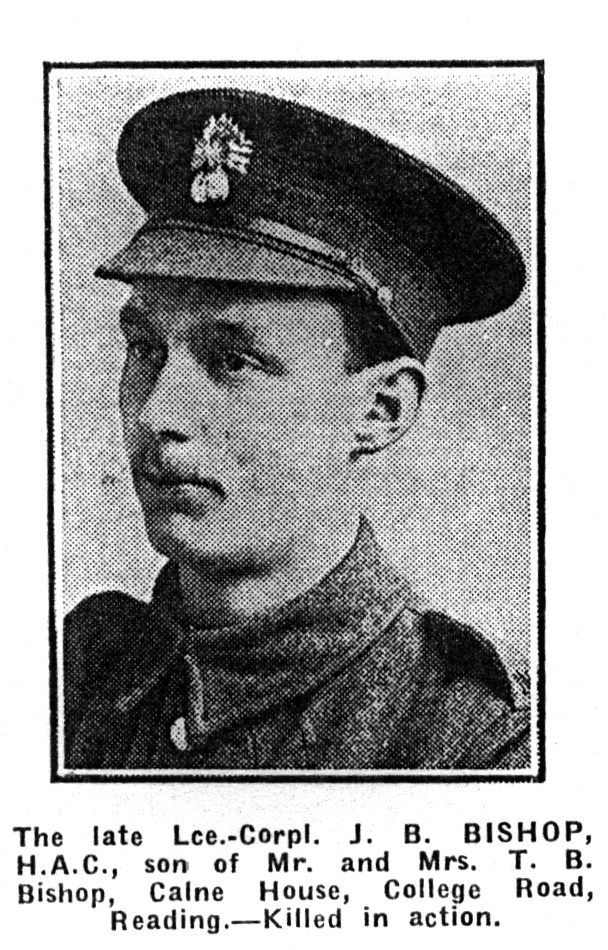
John Bryan Bishop

John Bryan Bishop
Lance Corporal 4653
1st Battalion Honourable Artillery Company

 Bishop JB photo

John Bishop was the son of Mr. Thomas Bryan Bishop and Mrs. Louisa Bishop, Calne House, 31. College Road.  In the family he was referred to as Jack. He was described as a young man of fine character and a good soldier who was well liked by all.   He was associated to both the King’s Road Baptist Church and also the Baptist Church  in Kingston-upon-Thames where he worked. He was killed in action at Gavrelle on 24th May 1917, aged 23 years and is buried at Mindel Trench British Cemetery, St. Laurent – Blangly on the outskirts of Arras. The grave location is C. 18. 

 The Chronicle of June 22nd 1917 outlined the circumstances of his death when it published a letter sent to Rev. R. Gordon Fairbairn of the King’s Road Baptist Church, by a mutual friend.  Jack “was killed the last time he was up in the trenches.  I made enquires and found he never suffered at all, and that although he lived for a few minutes he was unconscious all the while.  He was in charge of a party which went to draw rations.  They were just taking them from the wagon when a shell burst in the village, and Jack had a bad wound in his leg, and before the doctor arrived he was dead.  They did, of course, everything that was possible, but an artery was broken.”

 Gavrelle was part of the Vimy battle field and a German front line position in April 1917.  It was during the early actions described by Rose Coombs in “Before Endeavours Fade” that  John Bishop lost his life.  “Here was the scene of the attack by the 63rd Royal Naval Division* on April 23rd 1917 and their magnificent defence for many days thereafter through innumerable counter-attacks.  It was held until the 56th London Division, which stubbornly defended it in March 1918, were overwhelmed on the 28th.  The 51st Highland Division recaptured it on August 27th and it was occupied by the 8th Division”.   

(*The 1st HAC battalion was attached to the 63rd Royal Naval Division at the time of John Bishop death.)

A  further reminder of the struggle which took place on the battle fields around Arras is also located in St. Laurent- Blangly, here lies the large German cemetery where over 31,000 men are commemorated, many in a mass grave.

Fred Bird

Fred Bird
Lance Corporal 102
24
th Battalion Australian Imperial Force. 

 Bird Fred photo Bird Fred name

Fred Bird has no known grave, his name is commemorated on the Australian National War Memorial at Villers Bretonneux.  The small town had been well behind British lines until April 1918 and the German Spring Offensive.  The town was taken by the Germans on April 24th 1918 but recaptured the same evening by the Australians.  Twelve hundred Australians lost their lives in the battle.  The war memorial bears the names of all the Australians missing on the Somme battlefields. 

 From the top of the memorial  tower the Cathedral spire at Amiens, away to the west,  can be seen on a clear day and during spring and autumn months the trenches of the battlefield are outlined in the chalky soil.  It is not known what action Fred was involved in when he was killed.

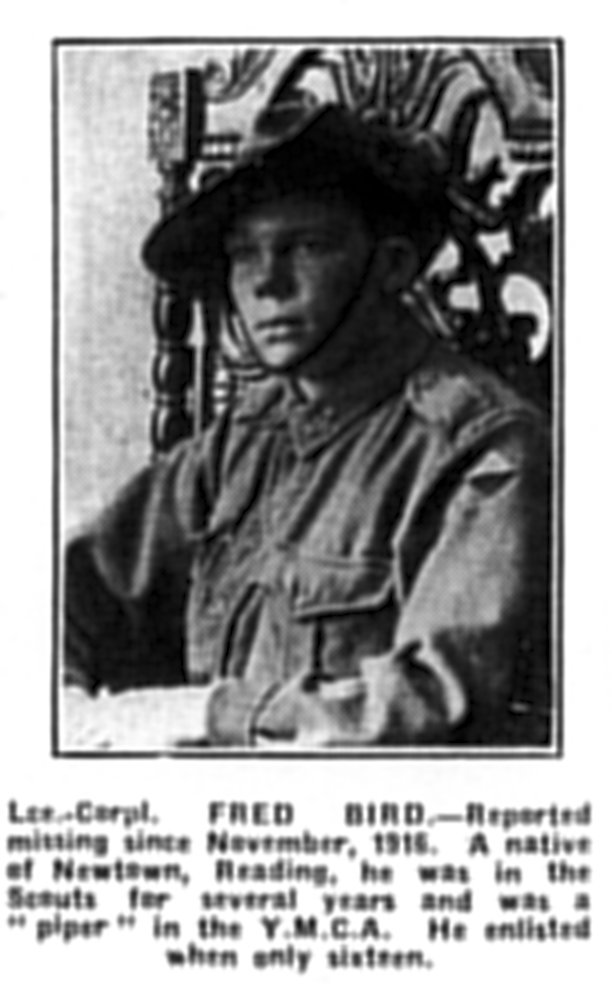
 Fred Bird had enlisted at the age of sixteen. A comment under the photograph published in “Berkshire and The War” states that he had been in the Scouts for several years and was a “piper” in the YMCA  He was also a native of Newtown.  Fred had reached the rank of Lance Corporal and had fought in the Dardanelles and France.  He was reported missing in November 1916 this was later confirmed as killed in action, he was in his 19th year. 

  “In Memoriam” The Standard 24th November 1917 gives the following details,  the youngest son of the late George Bird of Reading and Mrs. Bird of Mentone, Melbourne, and brother of Mrs. Wilkinson, Recreation Rd. Tilehurst.  In addition is a poem

 He heard the call of his country,
Far o’er the sea he came,
On Britain’s Roll of Honour
You’ll find the brave boy’s name.
The path of duty is the way to glory.

The 1911 census indicates that Fred and his family lived at 15 School Terrace, Newtown. His sister Ivy, then 15, was two years older than Fred. Fred’s father, George, was aged 72 and his occupation was given as Army Pensioner and Biscuit Factory Labourer. Fred’s mother, Kate was aged 56. Fred and George had been married for sixteen years.