Category Archives: Royal Berkshire Regiment

George Percy Bowell

George Percy Bowell
Private 3088
1st/4th Royal Berkshire Regiment

 Division 34
Bowell G photo  CIMG2005

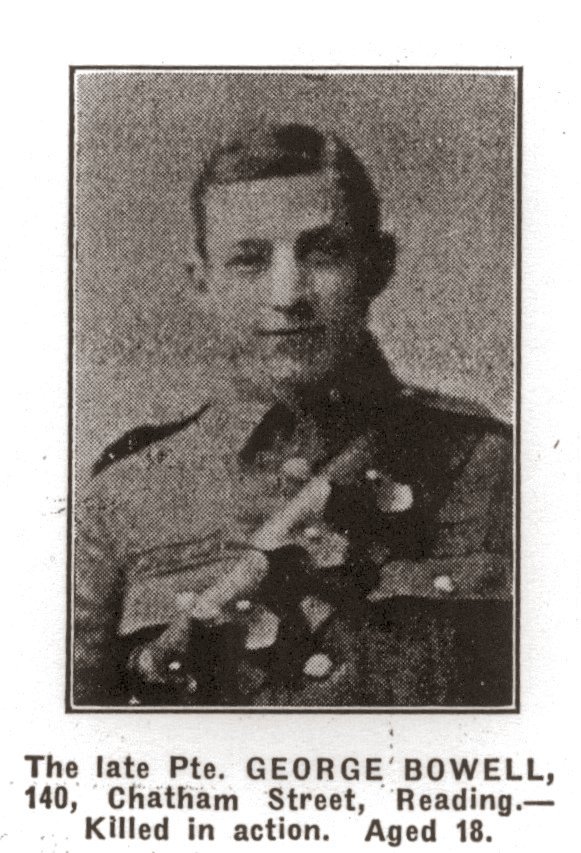
George Percy Bowell was the youngest son of Mr Richard and Mrs Eliza Bowell, of 140, Chatham Street, Reading.

 The Reading Standard 22nd May 1915 published an extract of a letter to his sister which describes his time in action on May 9th 1915. 

“Last Sunday, which was Hospital Sunday, we had our baptism of fire.  From 4.30 to 7am artillery bombarded the enemy’s trenches, at seven we opened fire and went on firing for an hour.  From nine to ten machine guns fired, and in the afternoon howitzers fired till four, when the artillery opened and went on till seven.  An enemy shell burst over the trench and wounded one of my section in both knees and tore two sandbags open.  So the day passed, and it was very exciting, I can tell you.  All the boys are keeping pretty fair.”

The battalion was stationed in Ploegsteert Wood (known to the men as Plugstreet).   The excitement about which George Bowell writes and which so enlivened his day was an event to fool the Germans into thinking that reinforcements were arriving.  The Battles of Souchez and Festubert began in the south on the 9th May.  It was important to keep the Germans interested in the normally quiet sector, rather than to allow them to think that they could thin their line and send men to join the southern battle.  For the battalion stationed in Plugstreet half a company of men, were sent marching for several hours, up and down the corduroy tracks in the woods, (these were roads made of wooden planking laid edge to edge,) thus creating extra noise, whilst their rifles were exhibited in the firing trenches.

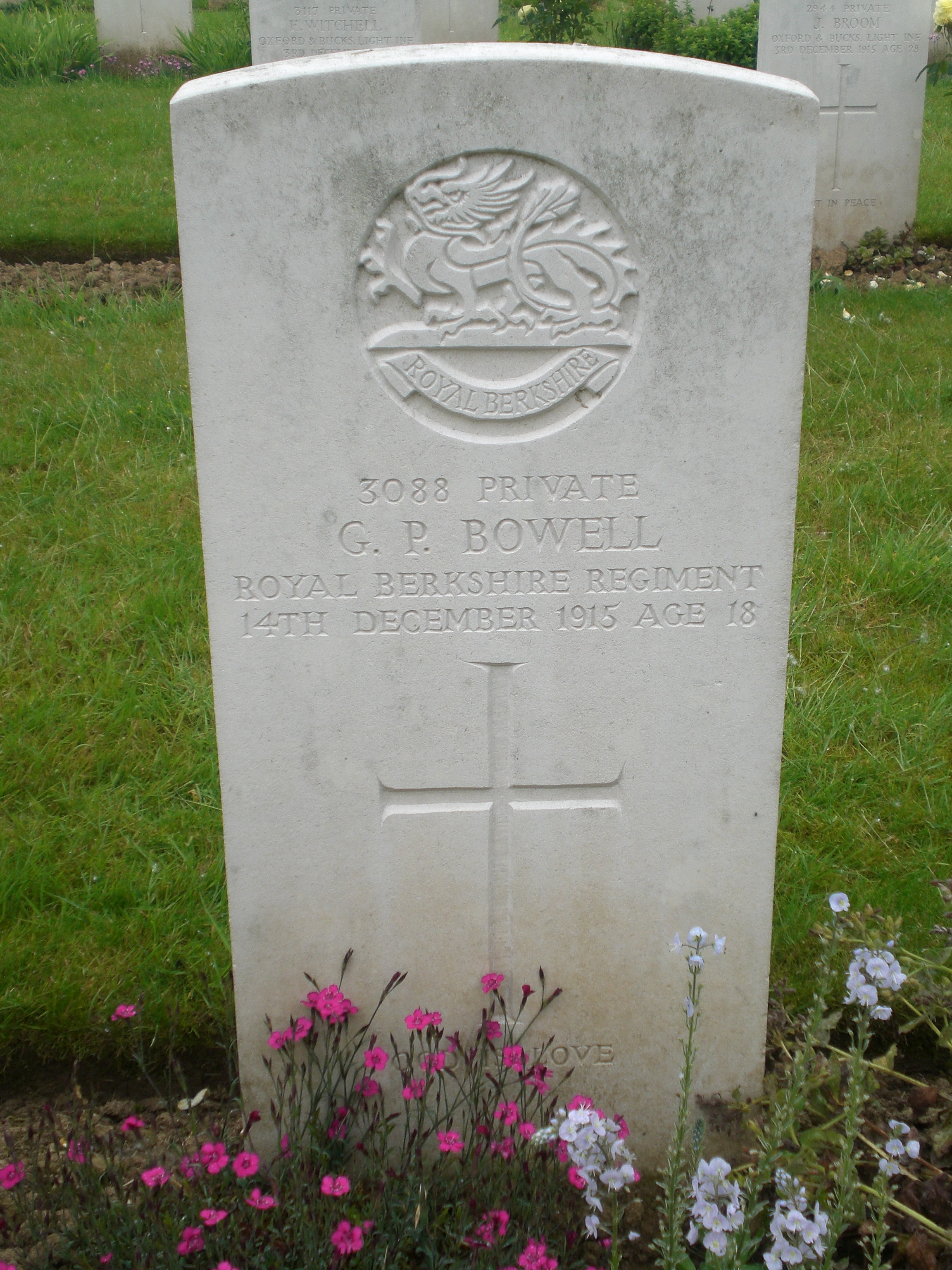
 George Bowell died on 14th December 1915, killed in action whilst on patrol, aged 18.  The notification was published in the Reading Standard 25th December 1915.  It is quoted in full.  

 “Educated at Greyfriars School, he was employed by Mr Cook, butcher, Alfred Street.  He joined the Territorials in October, 1914, and after being on active service nine months was expected home on leave shortly.  He was the youngest, or one of the youngest, members of his platoon, but was a smart, well built young fellow and would have passed for 24.  He played for Reading Invicta Football Club and was a good boxer, winning the officers prize even in France.  His parents learnt that he fell on night patrol.  He was popular with his comrades, as this letter from Sergt. William A. Roberts to his mother shows:

“May I offer you my deepest sympathy in the terrible loss you have sustained?  For nine months we had served together, and your boy was always one of the best soldiers, willing, brave, able and popular with all.  You will be glad to know that he died almost instantaneously and suffered no pain.  We buried him side by side with several others of the Berks.”

 George Bowell is commemorated on the family grave headstone in the Reading Cemetery. He is buried at Hébuterne Military Cemetery, France, location I.C.11.  

“Canon W. Welchman, the chaplain, who conducted the funeral wrote: “Although a stranger, I feel I must write to say how deeply I sympathise with you in the sad loss which has fallen upon you.  He was buried in the presence of many of his friends in a military cemetery.  Many will mourn for him.”

A friend, A. Blissett, writes:- “We are all sorry to loose him, for he was liked by everybody, and he died doing his duty, for which he was ever ready.  His Battalion Sergeant Major said what a good lad he was – in fact, he could not speak too highly of him.  His funeral was accorded full military honours and his mates were present to witness the rites.  I have a little memento belonging to George – it’s a pencil case which he brought out with him, and I shall prise it greatly, for it belonged to a good, cheerful, obliging and praiseworthy comrade,  When I am in the neighbouring village I shall place flowers on his grave.”

The Battalion were stationed at Hébuterne, having taken over responsibility for that part of the line on July 22nd 1915, after their initial training at Ploegsteert.  A major incident occurred in August but the autumn and winter months were relatively quiet.  There was the occasional fight with patrols challenged but no casualties were reported until 14th December when a party from “A” company were ambushed in a sunken road and one man, George Bowell, was killed and three injured.  The incidents relating to the ambush were reported in a Reading Standard article of 29th January 1916.

 “Before leaving France on a weeks leave Private Charles Chomley 1st/4th Royal Berks, was recommended for recognition for gallantry.  When Private George Bowell, of the same regiment, was mortally wounded, Private Comley and Lance Corporal N. Clayton were wounded too.  Clayton returned to the Berks., lines and fetched more bombs and went again, while Comley stayed with his dying comrade in the midst of great danger.  It appears that a party of the 1/4th were on patrol when the enemy opened fire upon them with a machine gun.  Comley, a Childrey lad, at the time of his distinguished conduct was only 17 years of age.”
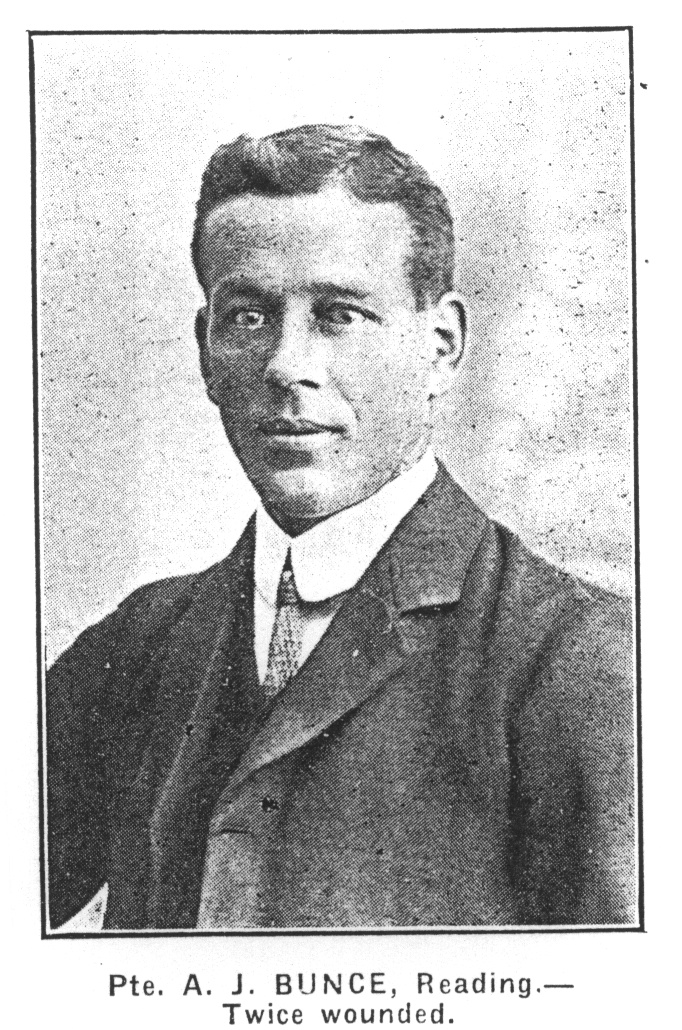


Arthur John Bunce

Arthur John Bunce
Corporal 8072
2nd Batt. Royal Berkshire Regt.

War Plot
Divisions 71 and 72

Bunce AJ photo

Arthur Bunce was the son of Mr and Mrs Alfred Bunce of 43, Alma St., Reading, and husband of Mrs F. D. Bunce of 12, Pell Street, Reading.   He died of wounds at the Reading War Hospital on 21st October 1918 aged 33.  He had been attached to the 8th Batt. Royal Berkshire Regt. Arthur Bunce has no headstone in the War plot but his name is commemorated upon the screen wall.

 The author has found only a little information about the military career of Arthur Bunce.  A report in the Standard 21st November 1914, states that he had been wounded in the stomach and severely bruised and taken to St. Nazaire Hospital on September 26th 1914.  At the time it is more likely that he was serving with the 1st Battalion Royal Berkshire Regiment, rather than the 2nd as they were on their way back from India.  The 1st Battalion had been in action at the Aisne, with heavy fighting and many casualties in the period between the 15th and 21st September. After a period of convalescence he returned to active service.

We next hear of him in a report from the Chronicle where he had again been wounded and was possibly recounting the attack during the Battle of Festubert.  When he received the wounds from which he died is unknown.  However, in the late summer of 1918 the 8th Battalion Royal Berkshire Regt. were part of the allied offensive in the area of the Somme, chasing the Germans back over the ground which had been so hard won in 1916 and so easily lost in the spring. 

Leslie Ernest John Beard

Leslie Ernest John Beard
Lance Sergeant  200528
2nd/4th Battalion Royal Berkshire Regiment.

Beard LEJ photo Beard LEJ name

The 2nd/4th battalion was formed in early September 1914 with men coming from all over Berkshire. Their first base was at Hitcham, in Buckinghamshire, on their commanding officers farm.  The War Office could not spare any equipment and kit was supplied initially by the general public. In November they moved to Maidenhead from where some two hundred men were sent to the 1st/4ths in exchange for a draft of men who were not passed fit for general service or who had not volunteered for service abroad.  Training at the time involved a good deal of route marching and drill.

In December the battalion numbered one thousand and their first task was the guarding of German prisoners-of-war at Holyport.  By February 1915 they were in Northampton, as part of the 2nd South Midlands Division, moving in April to Chelmsford where they dug trenches for the defence of London and patrolled the Essex roads looking for spies who might use  lights to signal enemy aeroplanes.  It was not until 25th May 1916 that the battalion finally left Southampton for France, ending up eventually at Merville near ArmentiÀres south of Ypres. After a short period of instruction in trench warfare attached to other battalions the 2nd/4ths took over trenches near Laventie.

The battalion took casualties from their first days in the trenches and these gradually increased as the men were involved in carrying out patrols to investigate enemy wire and trenches.  During the last week of June when the bombardment of the Somme was underway there was activity all along the British front line in order to keep the Germans guessing about where exactly the offensive would come. The 2nd/4ths were involved  in such work loosing several junior officers and men before retiring to billets on 27th June.  They went back into the front line on 6th July  moving to Croix Barbee on 13th July.  It was on this day that an elaborate raid on enemy trenches was carried out involving five officers and one hundred men.  The objective was the capture prisoners, identification enemy units and the  killing of Germans.

Officers and men were divided into ten groups some men were carrying a Bangalore torpedo which would be used to blow a gap in the wire.  The company set out at midnight and formed up, five yards between each line, in front of the British wire, in No-Mans Land.  When all was ready the first wave moved forward, but reaching the German wire found only a partial gap.  It was decided  to use the Bangalore torpedo but by this time the Germans had observed the movements and were shelling No-Mans Land.  The torpedo carriers were wounded in the shelling and the fuse lost.

Four or five machine guns opened up as the first wave cut through the wire by other means and “gallantly penetrated the enemy’s first line under severe opposition”. (Commanding Officers report)  The rest of the raiding party lost touch with the first wave and in a short time the signal was given for recall.  Three officers were wounded and two killed: six men were killed and eleven recorded as missing, fifteen men were wounded.

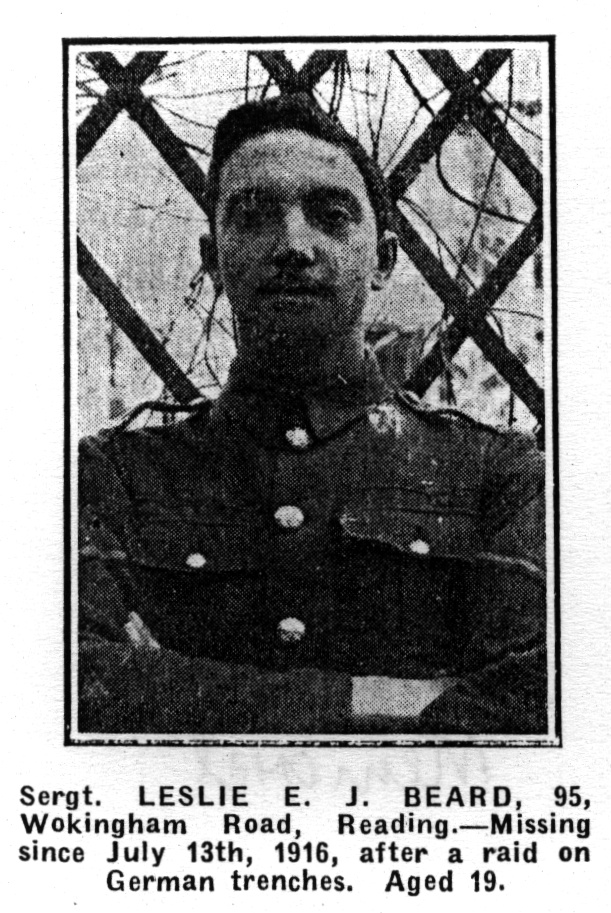
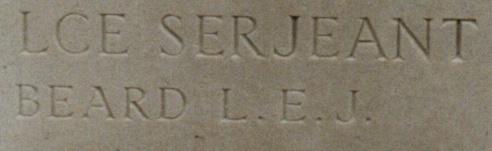
Leslie Beard was one of the missing and his name is recorded on Panel 93 the Loos Memorial to the Missing sited around the Dud Corner Cemetery. Leslie was the son of Joseph John and May Beard of 95, Wokingham Road, Reading.  His name  appears on both the Alfred Sutton School and the Park Church memorials.  He was 19 years old.