William Charles Bushell
Lance Corporal
8th Battalion Royal Berkshire Regiment
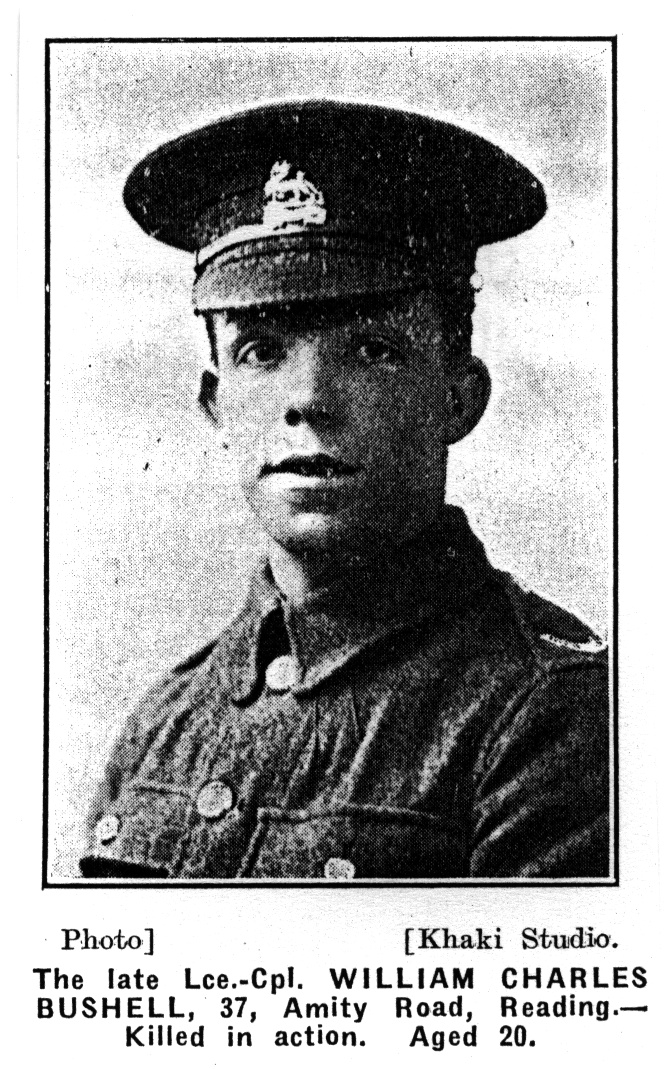 |
William Bushell had attended Newtown Council School before going to the Wokingham Road Senior School. His parents lived at 37, Amity Road and he was employed at the Reading Biscuit Factory until he enlisted on 5th September 1914. His father, W. B. Bushell, was a Private in the 4th Battalion Royal Berkshire Regiment.
A letter to his mother was published in the Chronicle 10th September 1915.
“Just to let you know that I have got through my first bit of fighting. We only had a short spell, going in on Tuesday and out on Thursday evening. It is rather a curious sensation when the bullets begin to whiz about over your head, and shells burst all round, but it never affected me or the rest of the company. No one was hit. We were troubled a great deal with snipers who had dug themselves in during the night. They started to try and pick us off. We ‘shut’ two of them up, but two others we were unable to touch. Aeroplanes were busy over our heads during the evening, and one plane had a hundred shells fired at it, but without result. It kept cruising about for a good while and the airman never moved any faster when being shelled than before, which says something for our airman’s nerve. Just before we got to our trenches we passed through the town of __________, and it was a sight I shall never forget. If only our slackers at home could have seen it, if they had any backbone in them it would have made them enlist. What used to be a fine church and big houses are reduced to heaps of bricks. There was not a sound building in the whole place. There was a lot of small wooden crosses with the names of heroes who had laid down their lives for their country. The place we were billeted at before we went into the trenches was bombed last night, and two were killed and a few wounded. We expect to go in the trenches again in about three or four days.”
William was with the 8th Battalion on the opening day of the battle of Loos, 25th September 1915. In “Responding to the Call” by John Chapman et al a detailed account of the battle which started September 25th 1915 is given. Training and rehearsals for the battle by the 8th Battalion had included bomb throwing “with live bombs” and preparations were made for the discharge of chlorine gas which the British Army used for the first time, some six months after the Germans first gas attack.
The order to “stand to” had been given at 3.30am and fix bayonets at 6am. Immediately a bombardment of the enemy trenches began and a release of gas and smoke. In the copses of La Haie and Bois Carre, in front of the attacking 8th Royal Berkshires and the 10th Gloucesters, the Germans had set up machine guns which caused many casualties in the attack across No Man’s Land. Eventually the 8th Battalion captured La Haie and had advanced 400 yards from their starting point. In a second charge the third line, at Gun Trench, was reached by 8.00am and the advance was now 1,200 yards. The final objective was to be Hulluch village but there was strong German resistance and eventually the 8th Battalion pulled back to form a line in Gun Trench. By noon of the 26th September the 8th Battalion had had no food since the morning of the 25th and with no water in their bottles they were suffering from thirst. A ration party sent out on the 27th September lost its way and the battalion was only finally relieved on September 28th.
William Bushell was killed in the action on the first day of the battle, ten days after his letter had been published in the paper. He has no known grave although in “Responding to the Call” a biography states that a charm found on his body was sent to his parent by his platoon officer. His name is commemorated on the Loos Memorial to the Missing, Panel 93. He was 20 years old.