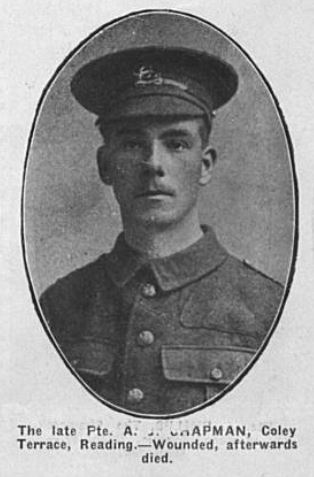
Alfred John Chapman
Private 7091
3rd Battalion / later 1st Battalion
Royal Berkshire Regiment.
Grave Location – Tilehurst St. Georges Church burial ground.
Private Alfred John Chapman, was born in Streatley and enlisted at Churn. He lived at 44, Coley Terrace, Reading.
The Reading Chronicle Jan 15 1915 (pg. 5 col. 5) published an account of his military funeral. Private Chapman had several years service in the militia being called up as a Reservist at the outbreak of war. He received a shrapnel wound in November 1914, whilst at the front and was for a time at the Cambridge hospital. On returning home his health gradually gave way and he died on 5th January 1915. Several members of Private Chapman’s regiment attended the funeral and the coffin was borne by 6 comrades, a firing party was in attendance..
A report in the Reading Standard Jan 16th 1915 stated that the funeral took place in the Reading cemetery. However, the grave number was unknown and several searches of the burial records later revealed that he was not in fact buried in the Old Reading Cemetery but in Tilehurst.
The 3rd Battalion Royal Berkshire Regiment
At the outbreak of war in August 1914 the Depot of the Royal Berkshire Regiment and the HQ of the 3rd Battalion (Special Reservists) was at the Barracks, on the Oxford Road in Reading.
The duties of the Depot and the 3rd Battalion staff centred around the call up and the provision of clothing and equipment for all the Army Reservists of the Regiment. In total about 1,800 were called up and 540 despatched to the 1st Battalion. Alfred John Chapman was almost certainly one of these men.
The remaining 1260 men went to Cosham, then Fort Purbrook, later they were based at the Victoria Barrack, Portsmouth and in November 1917 the Battalion was sent to Portobello Barracks, Dublin. During the war Petre tells us that the 21,605 officers and men passed through the 3rd battalion. 15,533 were sent to the BEF. The remaining 7,000is accounted for by transfers, discharges, deaths, desertions and demobilisation.
After the war men from all battalions of the Regiment were sent to the 3rd Battalion for demobilisation. This included returned prisoners of war. Demobilisation was a complicated affair and there were many grievances. “Pivotal men” i.e. those called up late in the war, largely employers, were let out first so that other men could have jobs to go to. However, the fighting men thought that they were being let out under false pretences. However, in Dublin, there was reportedly an excellent mess and occupations like football, cross country running, boxing, ceremonial parades and picnics in Phoenix Park kept the men busy. A added occupation involved the rounding up members of Sinn Fein. The 3rd Battalion was “disembodied” on 5th September 1919.