Category Archives: Other Regiments

Arthur Cyril Caudwell

Arthur Cyril Caudwell
Rifleman 6175
1st/16th Bn. London Regt. (Queens Westminster Rifles)

Division 55

Caudwell AC

Arthur C. Caudwell is commemorated on a large family headstone.  It is not clear exactly who his parents were and CWGC information has been difficult to trace. A search for “Caudwell” has consistently drawn a blank but a search for A. C. C. revealed that an Arthur Candwell was killed on 9th October 1916, there are no family details given and the soldier has no known grave and is commemorated on the Thiepval memorial to the Missing Pier and Face 13C. 

HIs military papers are available on Ancestry UK. He attested in November 1915 and was posted to France in April 1916. His brother Thomas, of 35. Bulmershe Road, Reading was given as his next of kin.

 The inscription on the family headstone states:
”Killed by a shell whilst guarding a trench October 10th 1916 Aged 36.
His body was buried by his comrades on the battlefield near Lesboeufs.” 

 At the time of Caudwell’s death the concluding battles of the Somme were taking place and the British lines had moved to a point a little way beyond Lesboeufs by October 10th 1916.  Lesboeufs had been captured on the 25th September by the British.  Earlier action on 15th September 1916 has seen the first tanks in action in the area west of Lesboeufs.  The Somme battle had concluded by 18th November 1916.

Although the body of Arthur Caudwell was buried on the battlefield and the grave was marked the continuous shelling in the period leading up to the end of the battle could have destroyed the grave.  In these circumstances identification after the war would have been impossible.   

More information was obtained from the Standard 28th October 1916 in the detailed “War Casualties” obituary column.  The article gave full details of how he died and confirmed that he was buried on the battlefield, the grave subsequently being lost.

 KILLED IN ACTION

CAUDWELL, Rfn. A.C., Queen’s Westminster Rifles.

“Mr Caudwell, who was an architect with Mr. Willets, builder, London, was an old Collegiate School boy.  His father for many years was with Messrs. Sutton and Sons, and his brother lives at 35, Bulmershe Road, Reading.

The Platoon Officer writes:- He was always bright and cheery, and is deeply missed by all his friends.  I myself, too, greatly regret the loss of such a reliable man.  We were in a trench where the shelling was pretty continuous, and “Caudie” as they all called him was on duty as a sentry in the early morning, while his friend Bunting sat next to him as the next for duty.  A shell burst on the parapet and buried all around with earth.  A piece penetrated his neck, and the force of the explosion knocked him right back into Bunting’s arms, leaving him unconscious.  Death was practically painless, as he never recovered consciousness.  Since he had to die I think he had all a man could desire; he fell at his post doing his duty to his country, and he died a painless death in the arms of his friend.  His friends buried him that night as soon as it was dark just behind the trench at great personal risk to themselves, as shelling and sniping were going on at the time.  One of them made a little wooden cross and marked it with his name and number, so that his grave might be identified.”



Victor Edward Burgess

Victor Edward Burgess
Rifleman 5824
2nd/17th London Regiment (London Rifles)

 Division 24

Burgess VE photo

Victor Edward Burgess was the youngest son of Mr Alfred Henry Burgess, of 15, Dorothy Street,  Reading.  He is commemorated on the family grave. Victor Burgess was killed on sentry duty on the 3rd  July 1916, aged 29.

 A report in the Reading Chronicle 14th July 1916 outlines the incident and gives details of his life before the war.  He had enlisted in October 1915 in the Royal Army Medical Corps.   Twice he had been rejected for service before being transferred to the London Rifles.  At the time he was killed Victor Burgess was on sentry duty and was struck by a grenade, dying instantly.  An officer writing to his father stated,” He died on duty and no man can do more for his King and country.  As one of his officers I feel his loss keenly.  He was one of the most conscientious men we had, and was very much liked by his comrades.  He was the first of his company to lay down his life for his country”.  Victor Burgess had been at the front only a couple of weeks.

 Victor Burgess had been born in London and came to Reading as a lad.  He had been educated at the Central and British Schools and then took up gardening for a livelihood. He had worked for the Rev. W.H. Mahony; Mr Martin H. F. Sutton; the Marquess of Ormonde (Kilkenny Castle); Mr Larnach (Lanwadie Hall, Suffolk); Mrs Adair (Engfield Green, Surrey; Rev. H.S. Musgrave, East Chitlington, Lewes.  Whilst at Lewes he had joined the Local Volunteer Force.  Victor Burgess was an active  member of the Y.M.C.A. and the C.E.M.S.

 Victor Burgess is buried at Ecoivres Military Cemetery, Mont-Saint-Eloi.  Location III.A.28.  Here successive Divisions used the French Military tramway to bring their dead in from the front trenches.

*February 22nd 2000

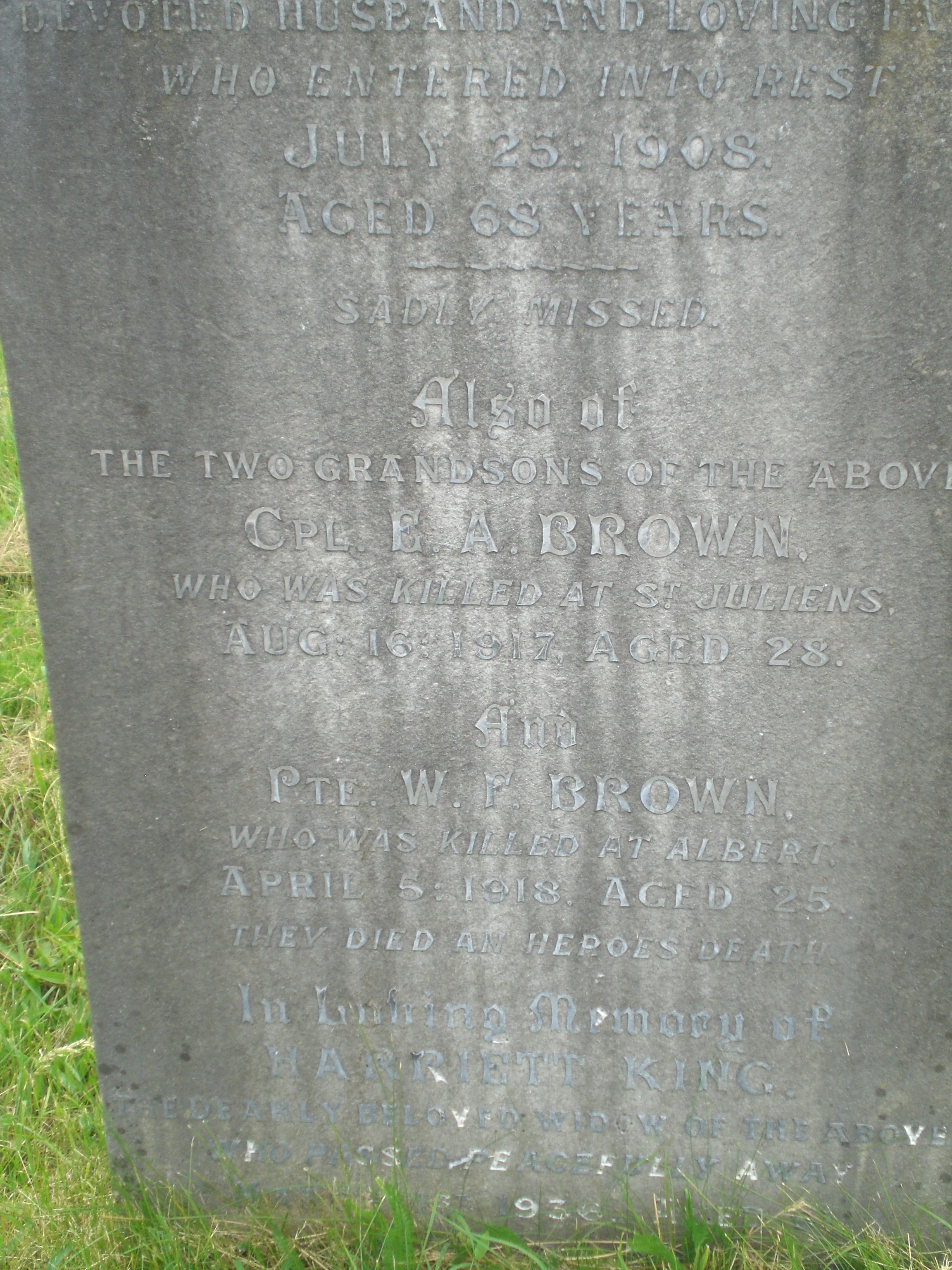
Ernest A Brown and William Frederick Brown

Ernest A. Brown
Corporal 203874
2nd Battalion Oxford & Bucks. Light Infantry

William Frederick Brown
Private 201425
5th Battalion Royal Berkshire Regt.

 Division 15

 Brown EA and WF photo

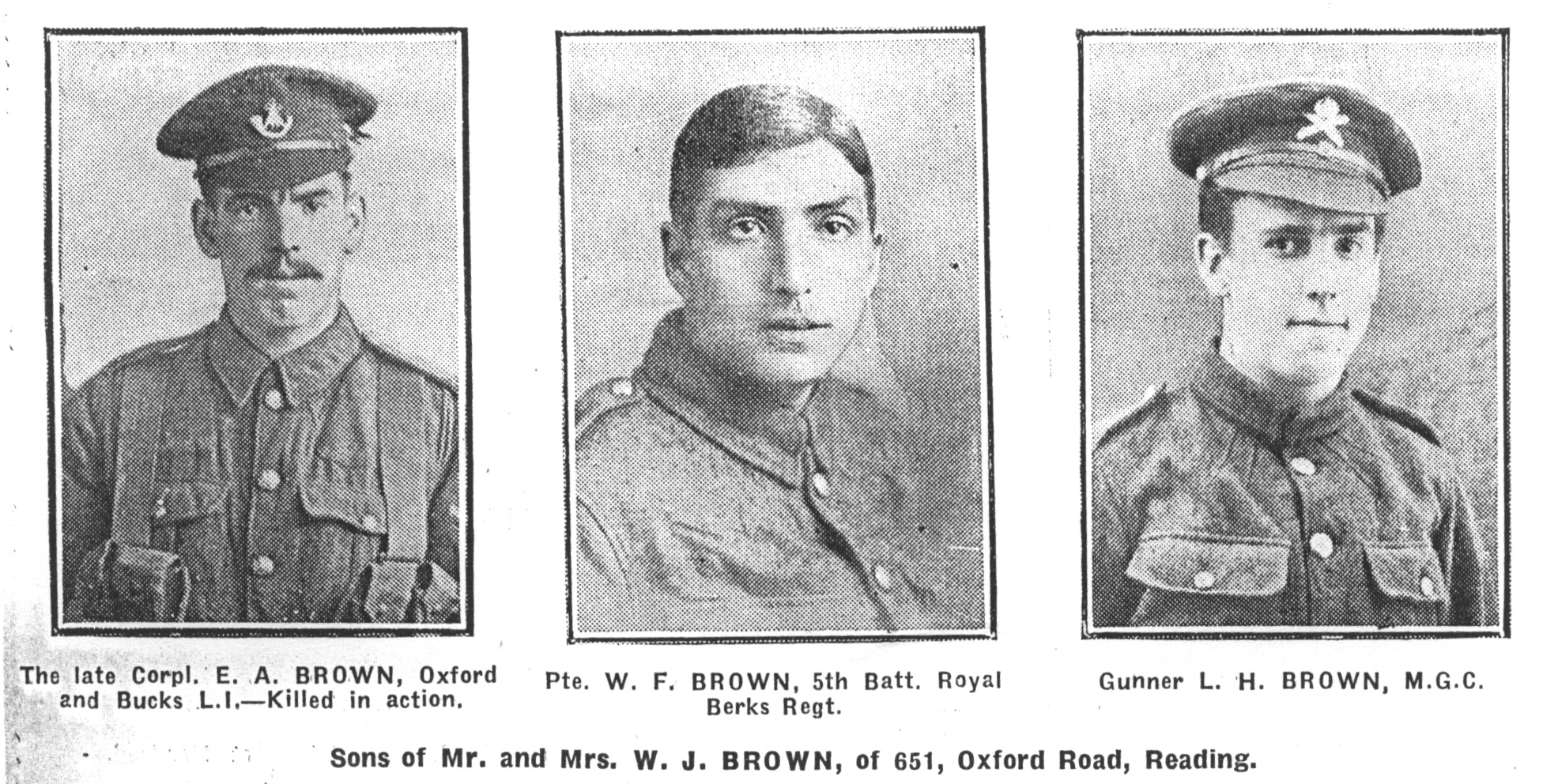
 Ernest and William Brown are pictured with their brother in Berkshire and The War.  Gunner L. H. Brown, served with the Machine Gun Corps.,  he probably survived the war.  Ernest and Frederick are commemorated on the headstone of the grave of their grandfather.  They were the sons of William J. and Ellen Brown, 651, Oxford Rd. Reading. 

CIMG2187


 The Standard September 15th 1917 printed the notification of the death of Ernest Brown. He was killed  during the 3rd Battle of Ypres.

“In everlasting memory of my dear husband, Corporal. E. A. Brown, Oxford and Bucks. Light Infantry killed in action August 16th 1917.”   

 Oh, how I longed to see him
After victory won,
But God thought it best to take him
Before the fight was won.
Sleep on dear Ern, in your lonely grave,
A grave I may never see,
But as long as life and memory last
I will remember thee.” 

Ernest Brown is buried in New Irish Farm Cemetery, Location XI.F.13.

 Frederick’s wife Francis Violet Brown posted the notification of his death.  Her address was given as 31 Manchester Rd., Reading.   Frederick was killed in action, on the 5th April 1918.  His death occurred  during the Battle of Albert, he was aged 28.  At the time the British were being driven back by the Germans who had launched their major offensive in the spring. 

No loving friends stood round his bed,
No loving mother closed his eyes,
No roof above his brave young head,
Only France’s cloudy skies;
No bell to toll the mournful tale,
With sad but kindly tone,
But we know he’s gone to a better vale,
His Heavenly Father’s throne.

 William Brown has no known grave and is commemorated on the Pozieres Memorial Panel 56 & 57.