Category Archives: Memorials

William Adnams

William Adnams
Gunner 129930
99th Siege Battery, Royal Garrison Artillery

Division 71
Extension

ADNAMS W CEM

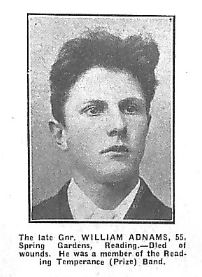
William Adnams died of gas shell wounds on 28th June 1916.  He was the son of William and Emily Adnams, of Reading.  William was the husband of Lizzie Adnams, of 55 Spring Gardens, Whitley, Reading.    He is commemorated on the family grave. Number 18121.  The Berkshire Family History Society classification is 71J13.

The notification of his death appeared in The Standard July 13th 1918 commented, “He was a dutiful son and devoted husband and beloved by all”, together with the following poem.
Not now, but in the coming years.
It may be in a Better Land,
We’ll know the meaning of our tears,
And then sometime we’ll understand.

 William Adnams was aged 32.  He was buried in Aire Communal Cemetery, pas De Calais.  Location III.E.5.  Aire was a peaceful centre used by Commonwealth forces as corps headquarters.  Burials in plots II.III.IV. rows A – F, relate to the fighting of 1918, when the 54th Casualty Clearing Station came to Aire and the town was, for a short time, within 13 kilometres of the German lines.

 *Further research is required to discover the service career of William Adnams.

Ernest George Edward Adams

Ernest George Edward Adams
Pioneer 103144
32nd Division Signal Company Royal Engineers

ADAMS EGE

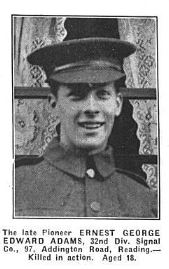
Ernest was the only son of Mr and Mrs Ernest Adams of 97, Addington Road.  Mr. Leonard Sutton, once the Mayor of Reading, raised both the 32nd and 35th Signal Companies, initially based at Wantage Hall.  He appealed to the young men of Reading to enlist and one such person was Ernest Adams.  Born in Reading he had attended Redlands and Wokingham Road Senior schools.  He had been employed in the Berkshire Insurance Committee offices.   Ernest was a well known and keen footballer, he played for a local team, the Corinthians, in the position of goal keeper.   

Ernest was only 17 years old when he was killed.  Theoretically he was too young to have served abroad and it is not clear when exactly he enlisted.  It is possible that he gave miss-information to the recruiting sergeant as many young men, eager to do their bit, often did.  With his father and four uncles also serving in the army Ernest was obviously keen to join them.  However, in spite of his age, we are told that he excelled at signalling and was with a sergeant engaged in new aerial signalling before he was killed. He must have been serving for some time in order to have gained sufficient training and experience.  Ernest was with his battalion on the Somme when he was killed on the night of 4th July 1916.  He would have experienced the allied shelling in the week before the ‘big push’ and would have been aware of the gains and losses made in those first few days.  He met his death, only a few weeks before his eighteenth birthday, when a shell burst near him, he lived for only three minutes after being hit.  The same shell injured many others.  

Ernest is buried at Blighty Valley Cemetery, Authuile Wood, the Somme.  Grave location I. B. 2. 

The cemetery was begun in July 1916 and used continuously until November 1916. The cemetery originally contained 212 graves in Plot I; it was not used again until after the Armistice when 784 graves were brought in from the battlefields and smaller cemeteries to the East, most of whom fell on the 1st July.  Authuile Wood, near the River Ancre,  was situated right at the heart of some of the most severe fighting which took place during the July 1916 Somme battles,  the missing dead of those battles being commemorated on the near by Thiepval Memorial to the Missing.  A cheery face looks out from his photograph and the “In memoriam” of 1917 refers to him as “Ern” a “dear and only son”.
William Henry Achurch

William Henry Achurch
2nd Lieutenant 
2nd/5th Battalion Royal Warwickshire Regiment
 

 ACHURCH WH

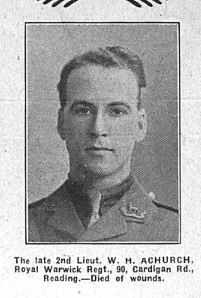
William Henry Achurch was the eldest son of Mr and Mrs Achurch, of 90 Cardigan Road, Reading.   He died of wounds received on the 6th December 1917, aged 25.  The Reading Chronicle of the 14th December 1917 carried an obituary.  The article states that he had been badly wounded in the chest.  The British launched a surprise attack at Cambrai on the 20th November 1917.  Ten days later the Germans attacked the salient and penetrated the British lines.  This was followed a few days later by a withdrawal from the area around Bourlon Wood and the eventually checking of the enemy.  The Battle of Cambrai officially ended on the 7th December 1917.  William Achurch is buried at Rocquigny-Equancourt Road British Cemetery, Manancourt, Somme, France.  Location VI. D. 14.

Rocquigny and Equancourt are two villages in the Department of the Somme, some 13 kilometres north of Peronne and 12 kilometres south-east of Bapaume. Rocquigny and Equancourt are approximately 8 kilometres apart and the Rocquigny-Equancourt British Cemetery lies about halfway between the two villages on the north side of the road just west of the crossing road from Etricourt to Ytres.  Etricourt was occupied by British troops at the beginning of April, 1917 during the German Retreat to the Hindenburg Line. It was lost on the 23rd March, 1918, and regained at the beginning of September. The cemetery was begun in 1917, and used (mainly by the 21st and 48th Casualty Clearing Stations, posted at Ytres) until March, 1918.

William Achurch joined the Yeomanry soon after the outbreak of war.  He was transferred to the Worcesters, promoted to the rank of Sergeant whilst on the Somme.  Later he was commissioned to the Royal Warwickshire Regiment, returning to England to train in Oxford.  He had been back at the front for four months when he was killed. He had seen a great deal of fighting.

William Achurch was a member of Wycliffe Chapel, a Sunday School teacher and Scout Master.  Before the war he worked for Messrs. Sutton and Sons.