Category Archives: Memorials

Roland Basil Howell & Norman Asquith Howell

Roland Basil Howell
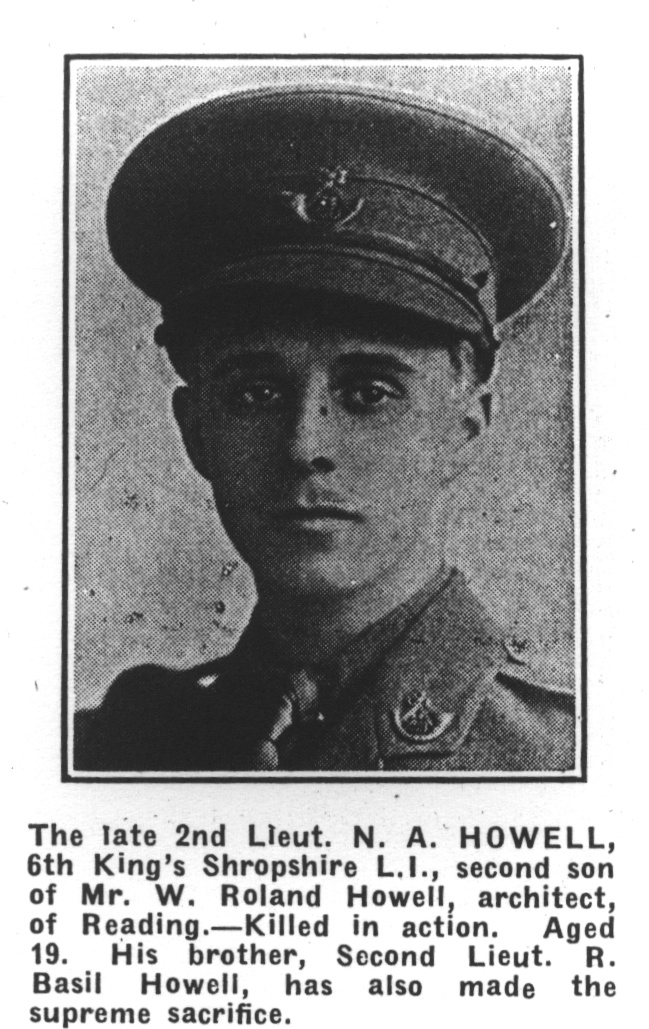
2nd Lieut. 6th Battalion King’s Shropshire Light Infantry.

Norman Asquith Howell
2nd Lieut. 4th Battalion North Staffordshire Regiment

Division 78

The Howell brothers were the sons of William Roland Howell and Louisa Margaret Howell, of “Heronden”, Cintra Avenue, Reading.  W. Roland Howell was a well known architect at the time.   The boys are commemorated on their parents grave, number 15603.
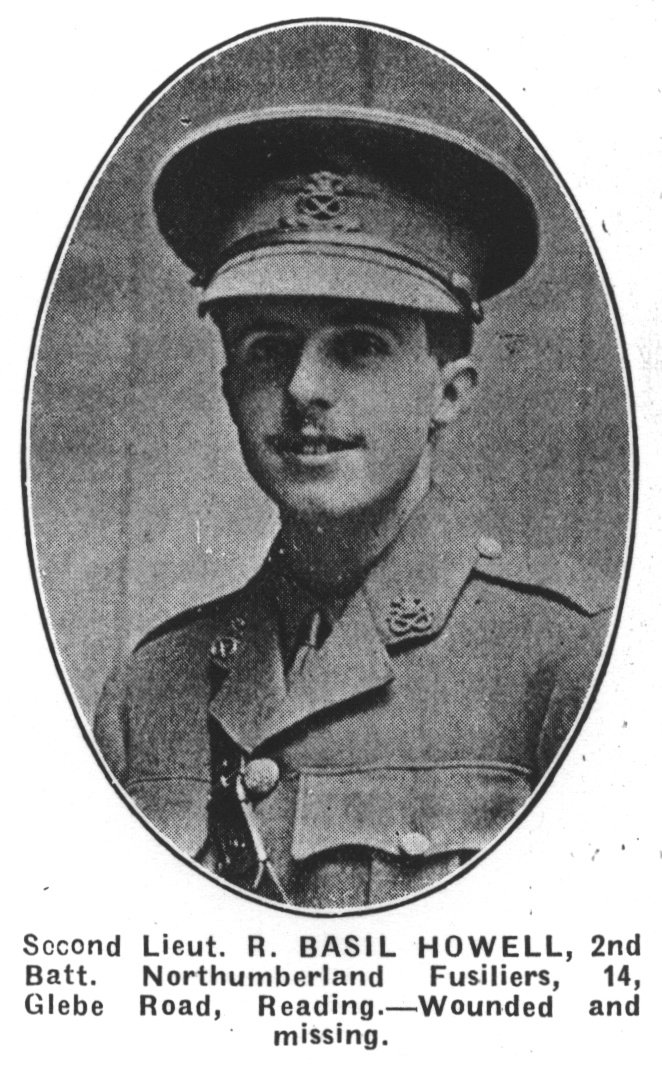
Howell RB photo Howell NA photo

Roland Basil Howell  was educated at St. Lawrence College, Ramsgate and volunteered for service in August 1914.  He was reported wounded and missing on 2nd October 1915, during the Battle of Loos.  He was aged 20.  His body was never found and his name is recorded on the Loos memorial, panel 103 to 105. Roland is commemorated on the University College memorial.

Norman Asquith Howell  was killed in action on the 23rd December 1916, aged 19.  He is buried in the A.I.F. Burial Ground, Flers, Somme.   The cemetery was started in November 1916 by Australians who were posted in nearby caves until February 1917.  The cemetery was greatly enlarged after the Armistice with graves from the battlefields.  It is likely, given the location, III. M. I. that Norman Howell was buried here sometime well after his death.

The Battle of the Somme was officially considered over in November  however, heavy fighting did continue for some time in the region of Flers.  A bitterly cold winter was also starting to set in and that Christmas was destined to be an uncomfortable one in the trenches with no hope of any truce or informal “live and let live” that had been the case at Christmas time at the beginning of the war.

Both Howell brothers are commemorated on the Reading School War Memorial.
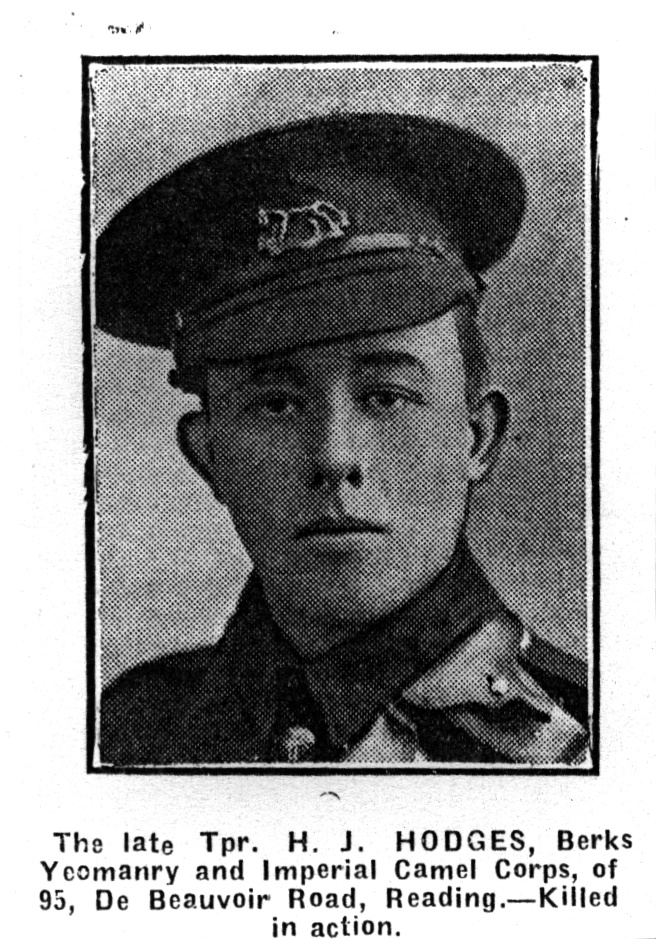
Horace John Hodges

Horace John Hodges
Trooper 50109
Berkshire Yeomanry and Imperial Camel Corps

Hodges HJ photo

 Horace John Hodges was the son  of John Henry and Alice Mary Hodges 95 De Beauvoir Road.  He joined the Berkshire Yeomanry in 1912 and was killed in action on 1st May 1918 aged 23.    In spite of the intimation that his body had been found he had no known grave and is commemorated on the Jerusalem Memorial panel 7.

Casualty Record Detail


An article, reproduced below, was published in the Reading Chronicle 26th June 1918.

Signaller’s Death 

Mr Hodges of 95, De Beauvoir road, Reading, has received the sad intelligence that his son Horace, who was a signaller, was killed in action on the banks of the Jordan on May 1st.  His Lieutenant writes that owing to the corps having to yield ground at the time the deceased was left where he fell with three or four others but on going over the ground again that night graves were found, the deceased no doubt being one of them.  The lieutenant added “he and all the boys had done well that morning, carrying out their duties and disregarding personal danger.  Signaller J. T. Rhodes, a Reading lad, who was formerly under Mr. W. J. Hodges in the Spring Gardens Band, writes: ”We were called out at midnight and had to march all night.  We had to  advance over the hills.  When we got in close contact with the enemy it was awful – absolutely raining bullets.  Poor Horace laid down and only fired one shot before he was hit, a bullet penetrating his heart.  His loss is deeply regretted by all his friends.”  Signaller Hodges joined the Berkshire Yeomanry six years ago, when he was 17 years of age, and arrived in Egypt with the first contingent on April 22nd 1915, the anniversary of his birth.  He had been in Egypt continually since that time, not having taken any leave.  He did not take part in the Gallipoli* fighting, as he was suffering from poisoning at the time, but he went through the Arab campaign, having been transferred to the Imperial Camel Corps, and has been in much sever fighting since his last letter, which has recently arrived telling of hardships and difficulties of the fighting in the Palestine hills.  He was 23.

 * When he recovered from his illness he was put in charge of the horses in Cairo.

James William Hewitt

Private 31858 “A” Company
6th Battalion Wiltshire Regiment

Hewett JW photo

James Hewett (known as Jim) was aged 19 years when he died of wounds on 18th November 1917.   His unit , part of the 19th Division, had fought from early June in the Battle of Messines until 10 November 1917 during the Second Battle of Passchendael. At that point the 19th Division was withdrawn and not involved in any furthr fighting until the following spring.  It is not know when James Hewitt received his injuries or their extent. He died in Abbeville where there were three hospitals and he is buried at Abbeville Communal Cemetery Extension, location III.E.7.  The Extension was started during July 1916. Abbeville was for most of the war the headquarters of the British Lines of Communication.

 His parents Mr and Mrs J. Hewett lived at 65 Grange Avenue.  An In Memoriam November 15th 1919 refers to mother, father, brothers and sisters.