Category Archives: Memorials

Charles Love

Charles Love
Sergeant 3435
2nd/4th Royal Berkshire Regiment

Division 59
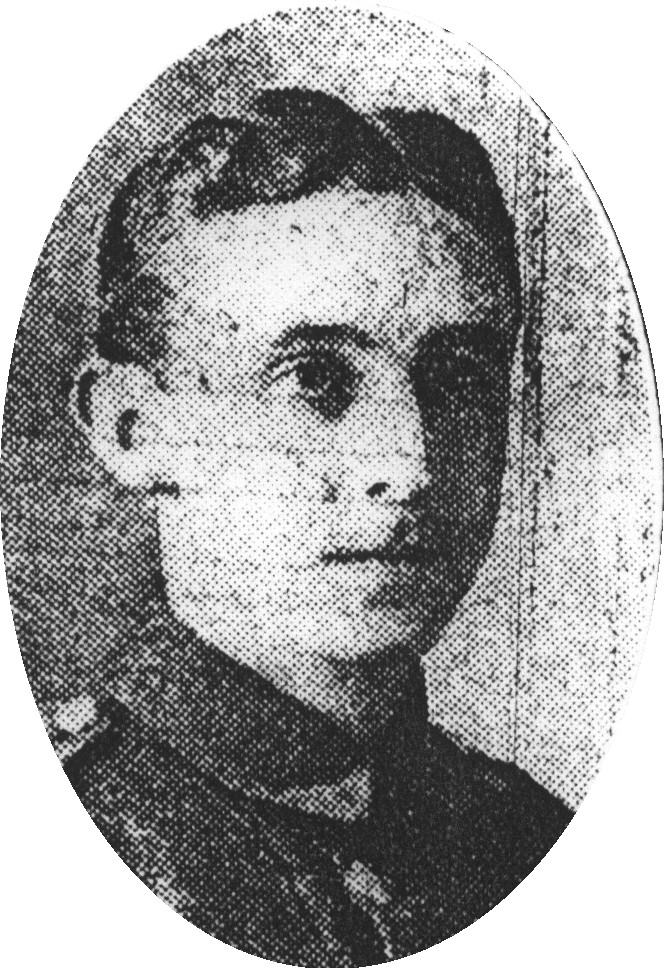
Charles Love

Charles Love was the youngest son of Mr George  William and Ethel Ann Love of 223. London Rd.   In addition to being  commemorated on the Alfred Sutton Memorial he is also remembered on his parents grave in Division 59 of The Reading Cemetery. He came from a large family with his mother giving birth to twelve children, three  of whom had died. The family were involved in the  trades of decorating and plumbing and George Love ran his own business. Charles was stated in the 1911 census as a house furniture assistant.

The formation of the 2nd/4ths and their time in France until July 1916 can be found in the section relating to Leslie Beard.  Charles Love  joined the battalion in 1914 and would have been involved in the actions previously recorded. It is known that he was  an instructor and lecturer although there is no specific information about this role.  In the weeks leading up to his death Charles Love would have experienced the following events.

Immediately after the unsuccessful trench raid in which Leslie Beard was killed the battalion had to make ready for an attack which was due to take place on July 16th.  The attack was delayed for several days due to poor weather, several men were lost in the intervening period as they were shelled getting into and out of the trenches.  On the morning of the 19th July the British artillery began shelling the German lines to soften them up in readiness for the assault in the evening at 6p.m.  However, the Germans replied with shells of their own which did a great deal of damage in the crowded front line trenches and many men were lost.  Further difficulties were experienced when the men tried to leave the trenches at zero hour via two sally ports and found that the Germans already had machine guns trained on the openings and many men were wounded or killed.  Those who did get through eventually had to fall back because of lack of support and because the German wire was uncut and prevented any forward movement.  Other units which had been involved in the attack, including the Australians, were also unsuccessful.   After this action the battalion was relieved and was not in the front line again until the end of August.  Although all of September and the first half of October was spent in and out of the trenches the battalion history records that there was “little to note.”   On the night of the 14th – 15th October a successful raid was carried out on German trenches by five offices and sixty men.  The men had moved out under the protection of a barrage and two Bangalore torpedoes effectively cut the enemy wire.   They were able to collect a great deal of information and cause a number of casualties among the Germans with only four men injured and one missing.   The battalion then went into training for a month and on their return to the trenches found themselves in the Somme sector at Bouzincourt near Albert from the 19th November.  It was here on the 26th November that they experienced a particularly heavy day of shelling and Charles Love was killed.  Information as to his death comes from various sources including a report in the Reading Chronicle.  He was recorded as “killed in action whilst on patrol” and  “killed instantaneously by a shell”, in these circumstances it would be difficult to retrieve a body and would account for the fact that he has no known grave.  He is commemorated on the Thiepval Memorial to the Missing on Pier and Face 11D.  He was aged 21 at the time of his death
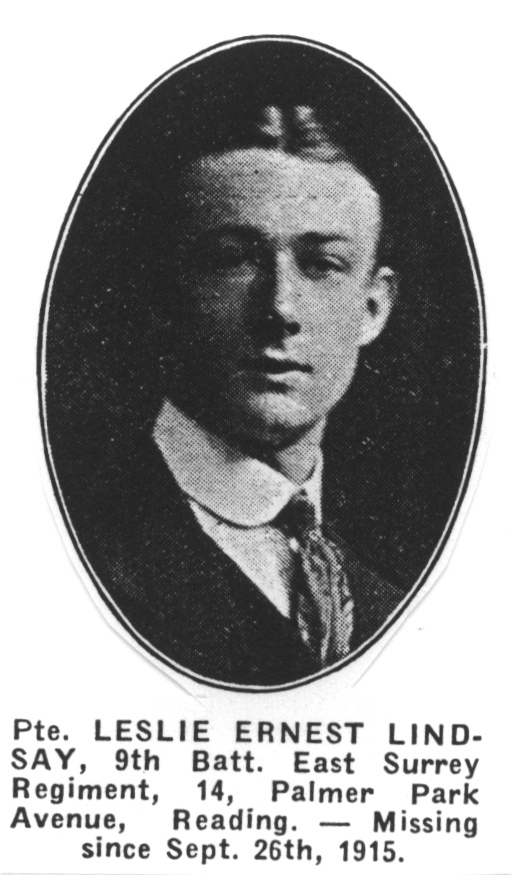
Leslie Ernest Lindsay

Leslie Ernest Lindsay
Private 2488
9th Battalion East Surrey Regiment

Lindsay LE photo

Leslie Ernest Lindsay was the son of George and Mary A. Lindsay, of, 14 Palmer Park Avenue.  He died on the 26th September 1915, the second day of the battle of Loos, aged 19.  Prior to the war, according to the 1911 census, he had worked for the Co-op.  He has no known grave and is commemorated on the Loos Memorial Panels 65 -67.  Specific details about the death of Leslie Lindsay are not known but a general account of the battle, particularly the second day, is set out below.

The 1915 BEF offensive in Artois was centred around Loos.  The Germans held the high ground and their second line of defence was well protected on the reverse slope.   They were well aware of the impending attack and their line was strengthened with well constructed concrete machine gun posts.  The German artillery tactic was to bombard the assembling British troops and to lay a barrier of fire across no man’s land once the attack had started.  Those men of the BEF who penetrated the barrier would be stopped by machine guns.  It was at Loos that the British first used chlorine gas in retaliation for the gas attack by the Germans outside Ypres in April 1915.  The discharge of gas hung around the battle field and even  drifted back into the British trenches, hindering rather than helping the advance.

Loos was to be the first testing ground of the “New Army”.  John Keegan in his book “The First World War” (page 218) describes the scene as the New Army 21st and 24th Divisions went into line on the morning of the 26th September and started their attack in early afternoon.

“….they moved forward in ten columns ‘each [of] about a thousand men, all advancing as if carrying out a parade-ground drill’.  The German defenders were astounded by the sight of an ‘entire front covered with the enemy’s infantry’.  They stood up, some even on the parapet of the trench, and fired triumphantly into the mass of men advancing across the open grassland.  The machine gunners had opened fire at 1,500 yards range.  Never had machine guns had such straight forward work to do …with barrels becoming hot and swimming in oil, they traversed to and fro along the enemy’s ranks; one machine gun alone fired 12,5000 rounds that afternoon.  The effect was devastating.  The enemy could be seen falling literally in hundreds, but they continued their march in good order and without interruption’ until they reached the unbroken wire of the Germans’ second position: Confronted by this impenetrable obstacle the survivors turned and began to retire.’

The survivors were a bare majority of those who had come forward.  Of the 15,000 infantry in the 21st and 24th Divisions, over 8,000 had been killed or wounded.  Their German enemies, nauseated by the spectacle of the ‘corpse field of Loos’, held their fire as the British turned in retreat, ‘so great was the feeling of compassion and mercy after such a victory’.”

Leonard William Levey

Leonard William Levey
Private 44209
2/23 Bn.East Surrey Regiment

Little is known of Leonard William Levey except that he waskilled in action on 2 September 1918 during the time of the final British advance. He is buried at Wulverghem-Lindenhoek Road Cemetery, location V.E.17.

The 1911 census spells his name as Lenard William Levy and gives his address as 101, Orts Road, Reading. There were seven children living at home between the ages of 25 and four years; Leonard’s age is given as eleven years. His mother had borne twelve children in total although four had died. Alfred Levey, father was recorded as a miller at the biscuit factory and of those old enough to work all except one were employed at the biscuit factory. In 1911 Leonard was still at school.

Two battalions of the 23rd were found during the First World War for overseas service with a reserve battalion at home. The 1/23rd fought in France and Flanders from March 1915 until the end of hostilities in 1918, being involved in actions at Festubert, Loos, the Somme in 1916 and 1918, Messines, Ypres, Cambrai, Lille and Tournai. Casualties were heavy, 237 being killed and 262 wounded at Givenchy during the Battle of Festubert. The 2/23rd went initially to France in June 1916 but later went to Salonika and then to Egypt to take part in General Allenby’s offensive against the Turks in Palestine. Finally they returned to France in 1918 and saw action around Ypres. http://www.queensroyalsurreys.org.uk/militia_vol_territorial/mvt19_1.html 

Leonard William would have been about 18 years old at the time of his death and it is not known when he joined his battalion. His name is on the Alfred Sutton School war memorial.