Category Archives: Memorials

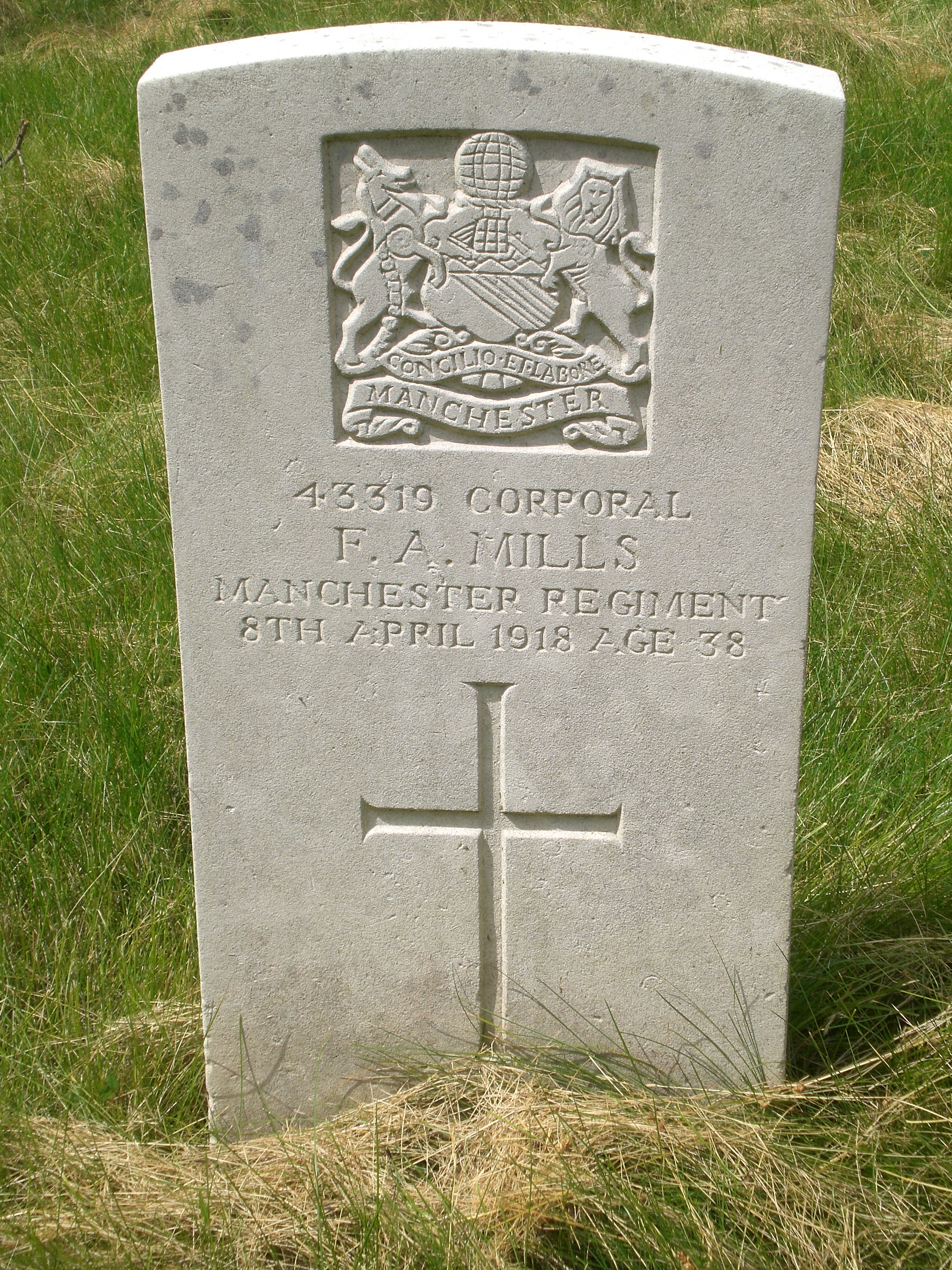
Francis Alfred Mills

Francis Alfred Mills
Corporal 43319
3rd Battalion Manchester Regiment, formerly 9th Royal Berkshire Regiment

 Division 46
Mills F photo  CIMG2203

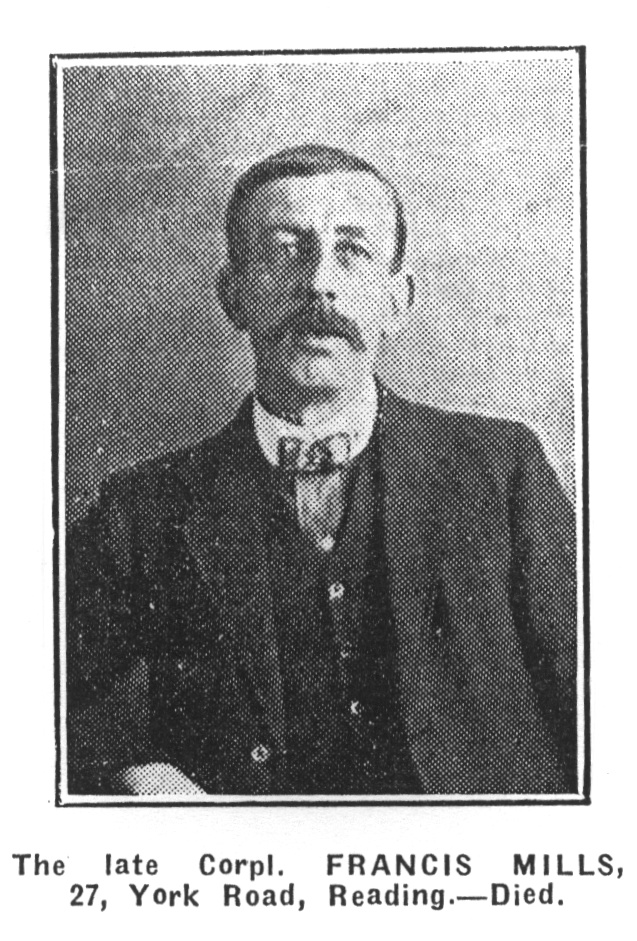
Francis Alfred Mills, was the son of Mrs Lucy Mills, of 26, Derby Street, Reading. The 1911 census indicates that he worked as a stage carpenter. At the time he was living with his widowed mother who was a nurse, his sister and two nephews. He married Katie Lovell on 19 June 1916 and they had a daughter Gladys Blanche Olive in November 1916. Originally assigned to the Royal Berkshire Regiment he was transferred to the Manchesters in September 1916. He was promoted twice during his service. His war records are quite extensive and indicate that due to his transfer to another unit his where abouts were not traceable for some time. Records also indicate that he died from a malignant tumour although this was not reported in the newspapers of the time.

His is a registered war grave and has a CWGC war pattern headstone, number 11429.

Corporal Mills died on 8th April 1918, he was aged 38.   He was buried with full military honours

Corporal F. A. Mills had been in the army for two years.  Eighteen months of service were spent in France. Papers reported that he had been wounded and that he was sent home with trench fever to which he succumbed in a hospital in Wales.  He leaves a mother and widow and child of 16 months.  Before joining up he was employed at the County Theatre where he was better known as Tom Viscent.
Walter May

Walter May
Lance Corporal 12760
6th Royal Berkshire Regiment

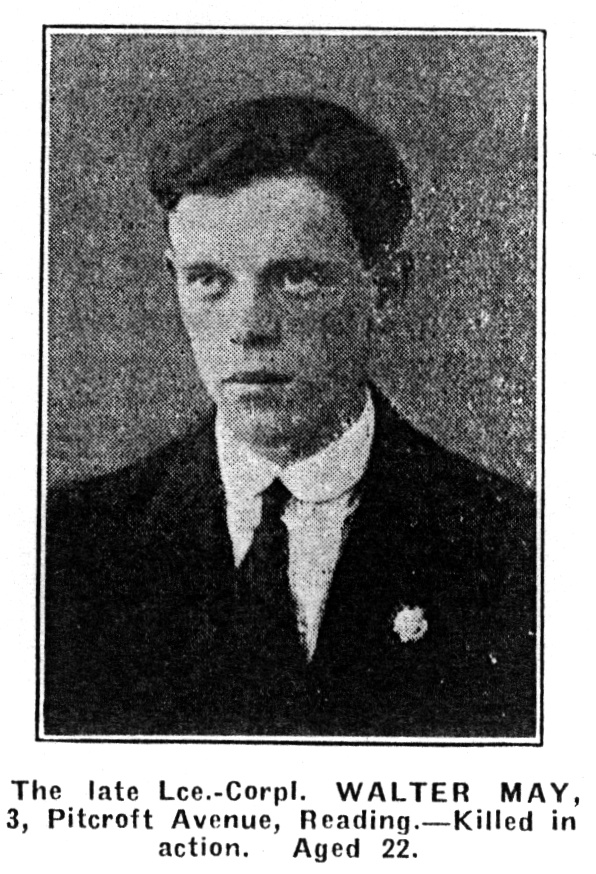
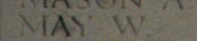
May Walter photo May W name

Walter May was the eldest son of Mr  Tom and Mrs Emma May of 3 Pitcroft Avenue, Reading.  The 1911census indicates that he was a Clerk Seedsman, probably at Suttons, his father and a younger brother also workedfor the same firm. Walter May had two sisters. He joined up on the 5th September 1914 and went to France on 25th July 1915.

The 6th Battalion Royal Berkshire Regiment, with which Walter served, was part of the 18th Division and was amongst those few battalions which had some success on the first day of the battle of the Somme.  They were situated on the far right of the British line near the French and achieved their objective,  the taking of Montauban.  The battalion was also involved in a fateful attack on Delville Wood on the 19th July when many men were lost in a badly planned operation.  The Somme battle continued wearily with great loss of men on both sides through the summer and autumn of 1916.  The 6th battalion was involved in the actions which finally resulted in the eventual successful capture of most of the Thiepval ridge from the Germans.

Thiepval had been a first day objective of the Somme offensive.  The 18th Division was given the task of taking Thiepval and also the strong point known as the Schwaben Redoubt.  “On the Somme” by Colin Fox et al., gives an account of the involvement of the 6th Battalion.  The Division had three weeks  battle training prior to the attack which was set for 26th September.  The 6th Royal Berkshire Regiment was in the brigade reserve with the 8th Suffolks leading the attack with the 10th Essex Regiment.  There were three days of preliminary bombardment with zero hour at 12.35pm on the 26th September.  The initial attack on Thiepval was very successful with the Germans, according to the Official History, eager to surrender without a fight.

However, progress towards the Schwaben redoubt was much more difficult and the advanced came to a standstill at about 6.20pm.  The 6th Berks now provided carrying parties with the task of bringing food, water and ammunition to the front line troops.  The reserve was in trenches at Crucifix Corner and it was here at dusk that the Germans sent over a massive barrage.  On the 28th September there was a renewed attack on the Schwaben Redoubt, the 6th Berks. were again in the reserve, this time in Authuille Wood.  The attacking battalions sustained heavy casualties and the following morning the 6th Berks. were sent in to relieve the Suffolks.  They were heavily shelled all day, and many of the men were suffering from a lack of sleep.  Walter May would have experienced the spasmodic bombing attacks carried out by both sides and the heavy shelling , which in deteriorating weather, reduced the ground into a sea of mud.  By the 5th October the Redoubt was back in British hands.   On the 6th October the 6th Royal Berkshire were withdrawn from the line and moved into billets.

Walter May was one of the 14 men killed during this action, he died on the 5th October 1916.   Walter’s body was never found and his name is commemorated on the Thiepval Memorial pier and face 11D. He was 22 years old.

Stanley Martin

Stanley Martin M.M.
Sergeant 200620
1st/4th Royal Berkshire Regiment 
and

2nd Lieutenant
2nd London Regiment, Royal Fusiliers

Sergt Martin, Stanley photo MARTIN S2 AS

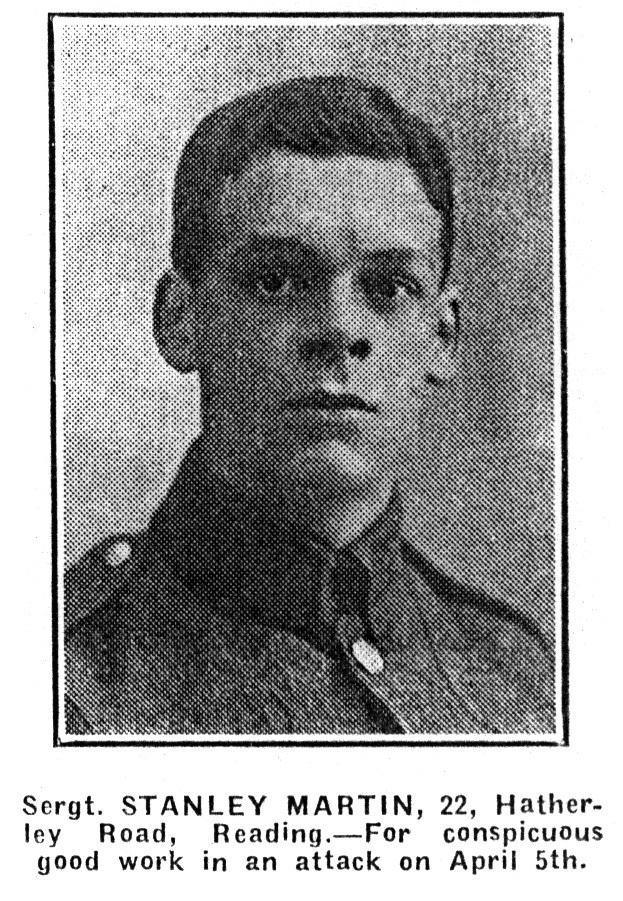
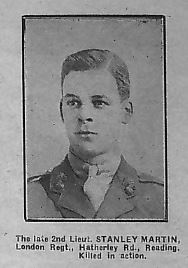
Stanley Martin was the son of Charles Alfred and Maria Martin who lived at 22, Hatherley Road Reading. The home address in 1901 was the same as the caption on the photograph. Charles Martin’s occupation was a cooper, by 1911he was a foreman cooper at the Huntley and Palmers Biscuit Factory. Stanley was the youngest of four children, he had two older sisters and an older brother. In 1911 he was still in school.

He enlisted in 1914 in the 1st/4th Royal Berkshire Regiment aged 17½ and reached the rank of acting C.S.M. when he was recommended for a commission being promoted to the rank of 2nd Lieutenant with the Royal Fusiliers.  He was still with the  1st/4th’s when he received the Military Medal for “conspicuous good work in an attack on April 5th 1917.

Details of the action were published in the Standard May 12 1917 in relation a Lance Corporal Herbert Degrucy of 29 Grosbrook Road, Caversham who, like Sergenant Stanley Martin  was awarded the Military Medal for conspicuous good work.  ‘During the attack on the villages of Ronssoy, Basse and Lempire, after the village was entered the company had to push on to link up with another battalion 1,000 yards through the village, and during the flight that ensued this N.C.O. showed great ability, being a great help to the C.O.  he set a fine example and displayed great bravery and devotion to duty.  Sergeant Stanley Martin, was awarded the Military Medal in connection with the engagement detailed above.

He was killed in action on September 18 1918 aged 24 years and buried at Ephey Wood Farm Cemetery, the Somme.  The village of Epehy was captured at the beginning of April 1917.  It was lost at the beginning of the spring offensive on March 22nd 1918, after a gallant defense by members of the 21st Division.  British defenses were broken through on this day and the allies made a hasty retreat.  The Germans claimed the taking of 16,000 prisoners and 200 guns.

The village was retaken on 18 September 1918 in the Battle of Epehy, which started September 12 1918.  The cemetery takes its name from the Ferme du Bois and Plots I and II were made by the 12th Division after the capture of the village, and contains the graves of the men and officers who died during the battle 18th September 1918.