Category Archives: Memorials

Sidney Edward Oates

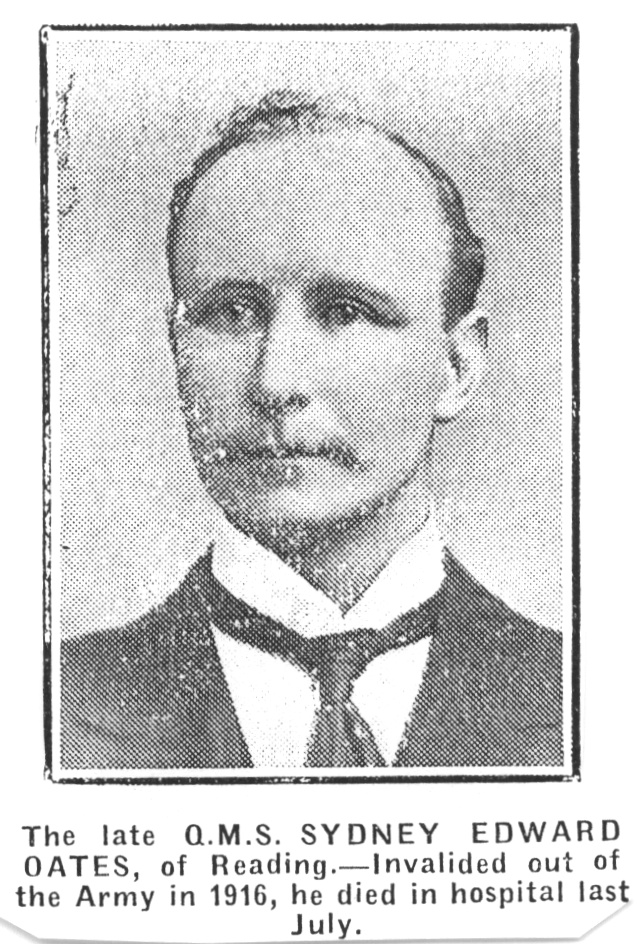
Sydney Edward Oates
Quarter Master Serjeant
3rd Battalion Suffolk Regiment .

War Plot
Oates SE photo screen wall

Sydney Edward Oates was the third son of late Mr & Mrs William Thomas Oates of “Moreton” Talford Avenue, Reading. Quartermaster Sergeant Oates died at Katesgrove Hospital.  In the Reading Standard of  August 11. 1917 he was described as “a gallant soldier and a keen, conscientious church worker”.  He was spoken of in glowing terms by his officers.  He had had a varied and honourable military career. It appears that his untiring energy in the early days of the war may have contributed to the illness which was the cause of his death.

Sydney Oates was born on Jan 12th 1870 in the parish of St. Giles and was educated at the British school, later going to the Blue Coat School.  Leaving school in 1884 he went into the ironmongery trade with Mr. Hawkes, High St.  He enlisted in the Suffolk Regt. on 7th Oct. 1889 and saw service in Egypt from 1889-1891, India from 1891-1892, and at home from 1893-1896 at Colchester and Warley.  He was on reserve for  3 years and served again with his regiment in the South African War, 1899-1902.  He remained in South Africa for some years after his 12 years service and on returning to England worked for Ocean Accident & Guarantee Corp. HQ in London.  He re-enlisted with the Suffolks on Nov. 12th 1914 and was stationed at Felixstowe.  He was invalided out in 1916 and passed away “bravely and patiently” as a pensioner.

The funeral took place with full military honours.  Chief mourners included Miss Gibbs & Pte. H. M. Oates, Canadian Expeditionary Force and his sisters.  Their were a large number of floral tributes.

His major wrote when he had to leave the battalion through ill health”  I should like to take the opportunity of thanking you for all the good work you have done from the time you came up until you were most unfortunately incapacitated….I personally owe you a deep debt of gratitude for your loyal and devoted services during a period when failure meant disaster….I know how grieved you are at being unable to see the war through, but rest easy on that score.  You have done your duty”.

His name is entered on the screen wall in the War Plot. His extensive service records are available on Ancestry UK.
Cedric Charles Okey Taylor

Lieutenant C.C. Okey Taylor
3rd Battalion East Kent Regiment (The Buffs) & Trench Motar Battery

Division 48

OKEY TAYLOR CC  CIMG2137CIMG2138

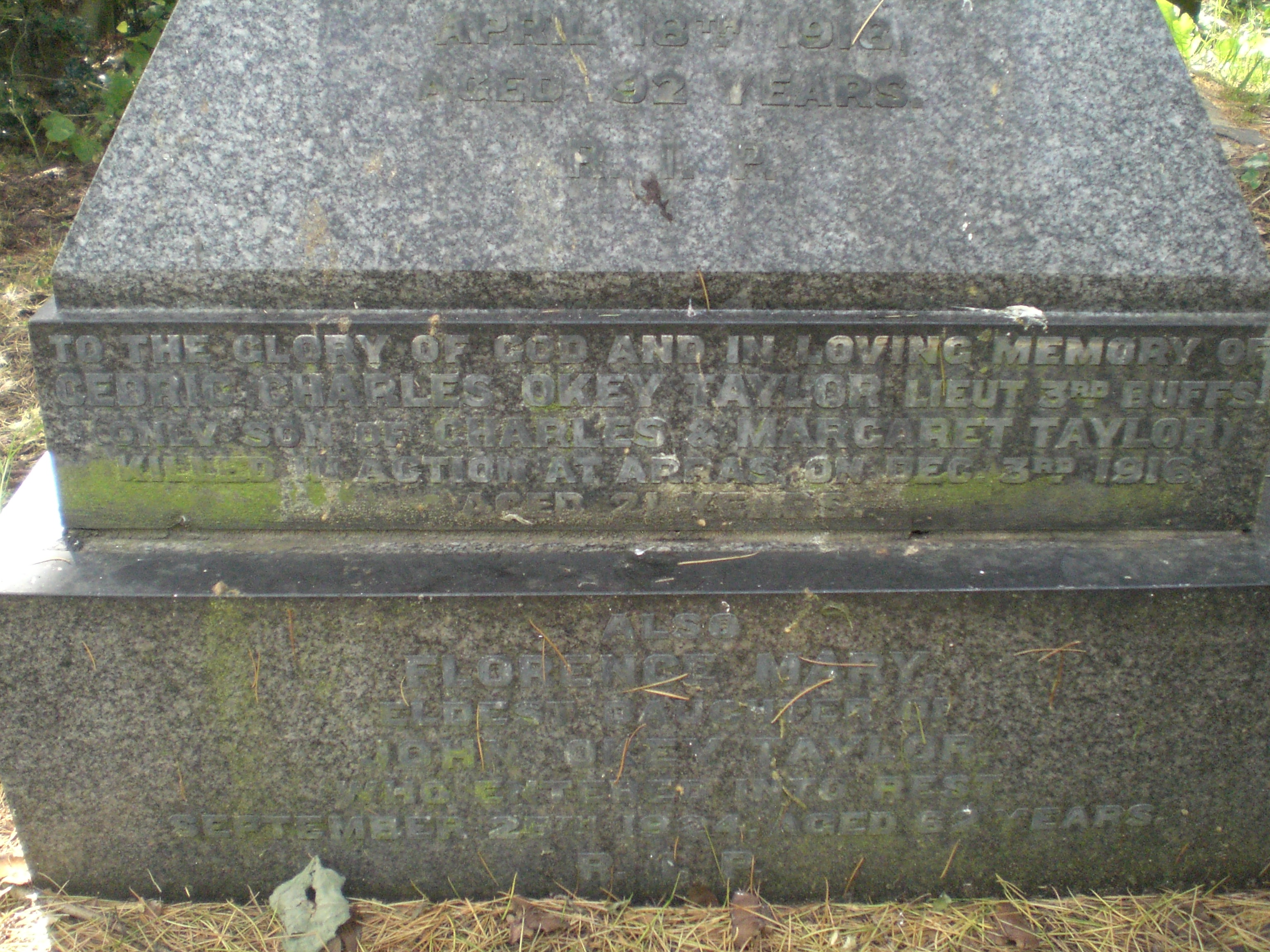
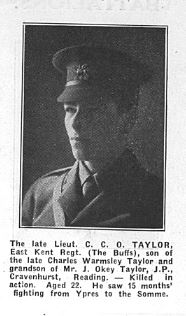
Cedric Charles Okey Taylor  was the grandson of a local Reading dignitary. His death is reported in The Chronicle of 15th December 1916.

“Attached to the Trench Motor Battery Z/14, 14th Division, BEF, France, fell in action on Sunday, December 3rd 1916.  He was not quite 22 years of age and the only son of Mrs. Taylor, of 31, Weltje Road, Ravenscroft Park, London, and the late Charles Warmsley Taylor, of Reading.”

His Captain communicated the news to his mother.

“He was at a gun position with his men when the dug-out was blown in.   His death must have been instantaneous, and two of his men were killed with him.  We have recovered his body, and he will be buried tomorrow, and as many of his brother officers that are available will attend.  I need hardly say how deeply sorry all his friends are, and to me it I is a personal loss, since he has been associated with me  longer than any other officer, and we have been together since he joined the Expeditionary Force.  One cannot speak too highly of his ability, his devotion to duty, and the keen interest he took in all his men and their welfare.  It is a sad loss which we all feel, and offer you our deepest sympathy.”

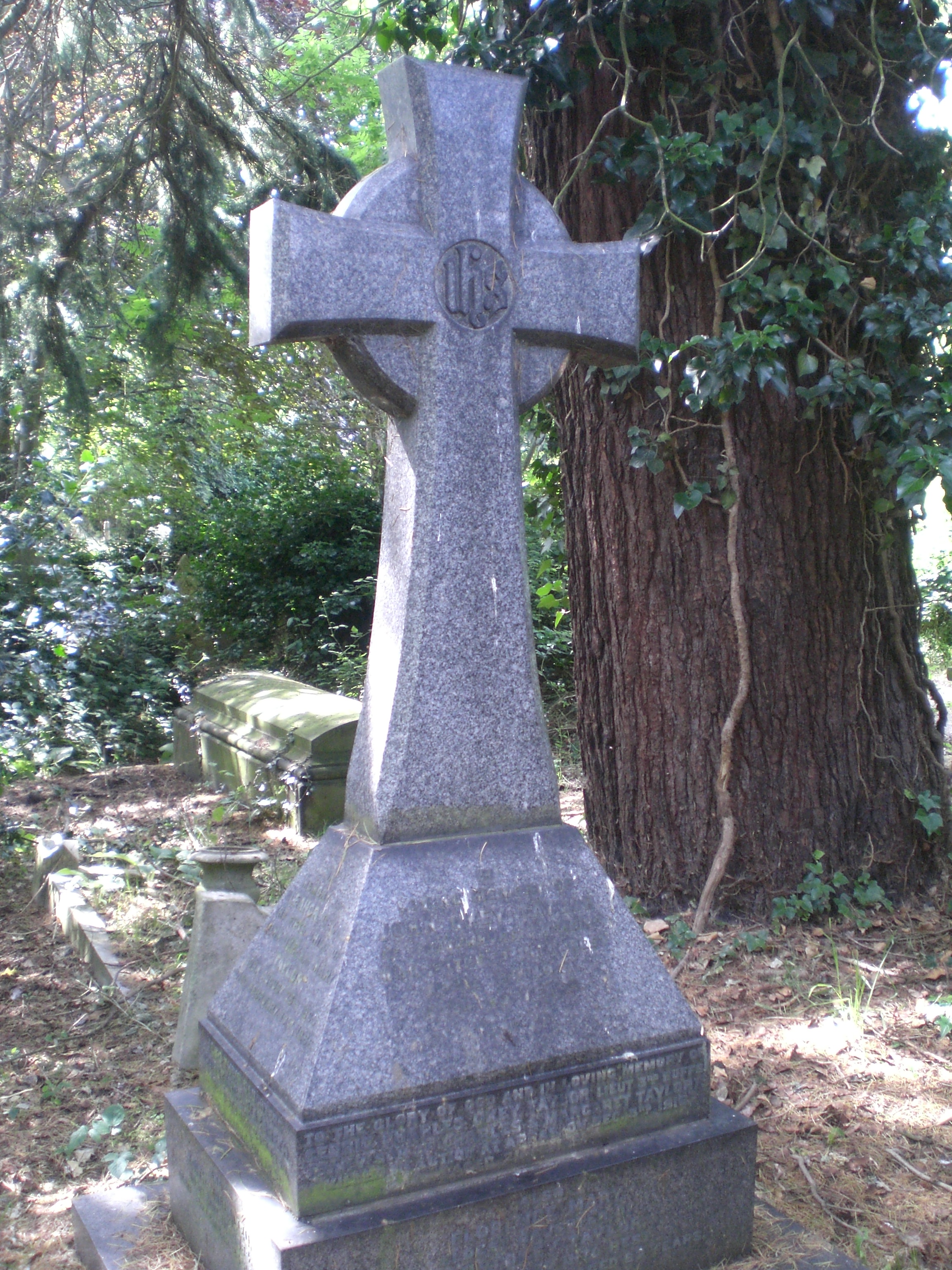
He is commemorated upon the grave of his grandfather in the Reading Cemetery and is buried in the Faubourg D’Amien Cemetery, Arras. Location I. J.58.

Upon his death he left his estate to his married sister Olive Margaret Okey Allner.

Reginald Newport

Reginald Newport
Signaller 20221
3rd (later 7th) Battalion Worcester Regiment

Newport R photo Newport R name

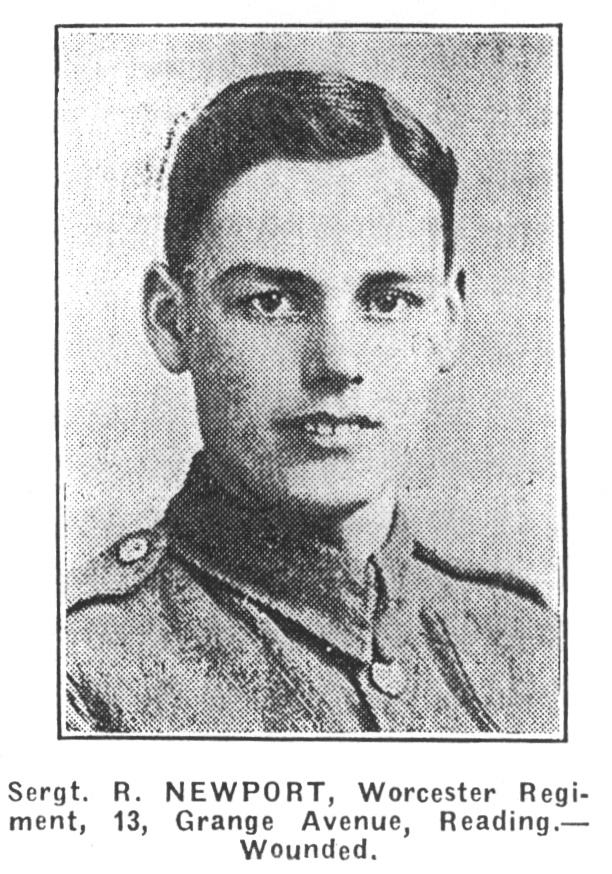
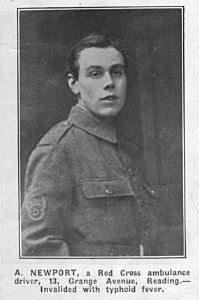
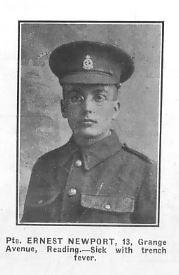
Reginald Newport was the son of Tom and Caroline Newport, of 13 Grange Avenue.  The 1911 census indicates that he had two older brothers Albert and Ernest and an uncle Henry living in the family home. Father Tom was recorded as a wood saw sharpener at a timber merchants, Henry was a carpenter, brother Albert an apprentice to a motor engineer and Ernest a plumbers assistant. Reginald then 13 was still at school. Pictures of the brothers has been obtained from Berkshire and the War but it has not been possible to find any further details about their military service.

 NEWPORT A NEWPORT ERNEST

Reginald was last seen on 26th April 1918 and was reported missing.  Parents were often desperate to find out where and how their sons had died and frequently had requests for information published in the papers.  Reginald Newport’s  mother was still seeking information about his end in a brief article published in the Standard October 18th 1919, his picture was published on page 7 of the same paper:

 “203221 Sig. R. Newport – 7th Worcestershire Regt. Reported missing on April 26th 1918, now assumed to be dead.  If any returned soldier knows anything concerning his end, would they kindly communicate with Mrs. Newport 13 Grange Avenue.”

In March 1918 the Germans began what was known as the “Spring Offensive”.  Beginning with a long bombardment and using specially trained storm troopers the attack began with increasingly ferocious trench raids followed by Operation Michael which was aimed at the junction between the French and British Armies on the Somme.  This was followed by Operation Georgette, along the River Lys.  By 11th April Armentieres was evacuated and Haig issued this famous speech to his men “…..Every position must be held to the last man: there must be no retirement.  With our backs to the wall….each one of us must fight to the end.”   On the 15th April the bloodily won ridge of Passchendaele was evacuated and the British divisions withdrew to a line around Ypres which approximated to that of 1915.  The British were below full complement and the new men, replacing those lost in Third Ypres, were young and incompletely trained, although they fought bravely.  On the 20th April there was a massive gas bombardment of the British line followed up by a further bombardment on the French on the 25th April.  The Germans moved seven divisions forward and the British fell back to Dickebusch Lake.  Whilst the French took the major force of the attack the British eventually were able to hold their positions.  On the 29th April the Germans renewed their attack but it failed.  The Second Battle of Lys was over.  Losses were heavy 76,300 British and 35,000 French.  (German casualties amounted to 109,300).  Among the British losses was Reginald Newport.

Reginald Newport has no known grave and his name is commemorated on the Tyne Cot Memorial to the Missing panels 75/77. Reginald Newport died aged 20 years.