Category Archives: Registered War Grave

Albert Edward Haines

Albert Edward Haines
Private 201694
1st/4th Battalion
Royal Berkshire Regiment

Division 79
Extension

Albert Edward Haines was the youngest son of Walter and Annie Haines. He is remembered on the kerbs of his parents grave although the lead lettering is now badly damaged and the actual wording very indistinct.  Albert died 17 August 1917.
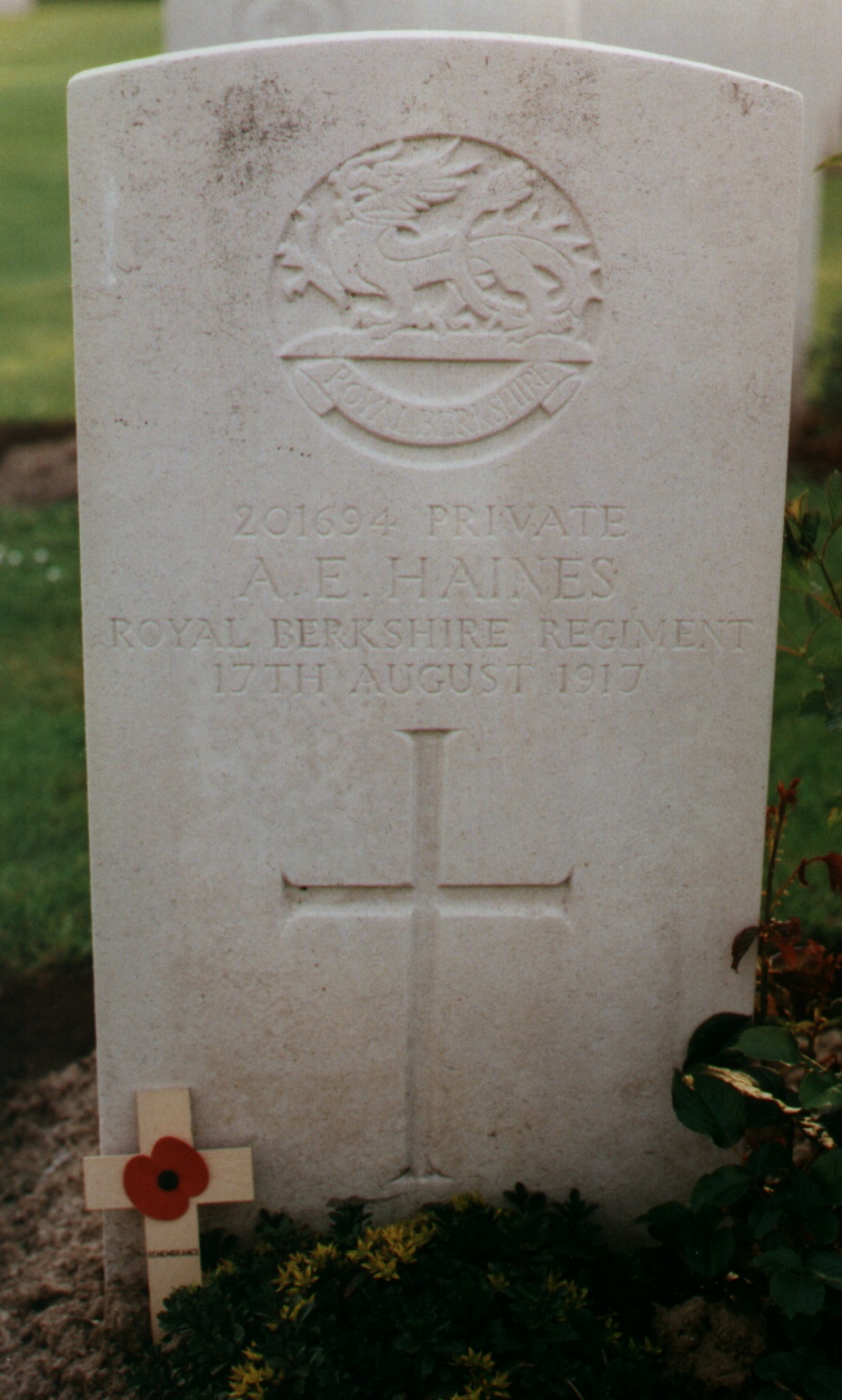
Haines AE grave


Albert Haines is actually buried in New Irish Farm  Cemetery Location X.E.I.  This cemetery was begun in August 1917 and used until November 1917, and again from April to May 1918.  By the time of the Armistice it contained 73 graves in Plot 1.  After the Armistice it was used as a concentration cemetery taking graves from smaller cemeteries and also bodies from the battlefields.  There are now 4,500 casualties commemorated in the cemetery. The body of Albert Haines was initially buried in one of these smaller cemeteries at the time of his death and moved after the Armistice.  

Albert Haines would have played a part in the action (The Battle of Langemarck),  outlined below which was part of the Third Battle of Ypres.   On the 16th August the British, on the northern flank of the battlefield,  took the village of Langemarck, although the they were subjected to strong counter attacks. On the southern flank, the most important, there was failure. (Martin Matrix Evans)  It is not known whether Albert Haines was killed in action or if he died of wounds.*

  For the 1st/4th’s their time in Flanders was one of their worst.  It seemed to the battalion that they were given impossible objectives and reinforced with inadequate reserves.  In the attacks, at dawn on the 16th August, the 48th Division made little progress and they were reduced to hanging about under heavy shell fire moving into gaps against threatened counter attacks.  The battles against pill boxes, gun pits and fortified farms were slow.  Each objective was taken methodically by bombers rushing, as best they could through a ground of liquid mud in full kit, and throwing bombs through loop holes this was followed by concentrated machine gun fire.  “A” company was hit by the opening barrage which killed their captain and wounded their other officer but they managed through the day to repel some small attempts of counter attack.  “B” company also experienced difficulty getting through the barrage and spent most of the day in support of “A” company and without actually coming into contact with the enemy lost forty men.  “C” company took part in fighting around the Langemarck road and lost all their officers and fifty men.  “D” company did not move until the barrage had eased and spent most of the day in support of the Buckinghamshire battalion, they lost thirty men.  By the end of the day one third of the 1st/4th Battalion’s strength had been lost.   (From “The School,The Master, The Boys and The V.C” thestory of the  Alfred Sutton School War Memorials )
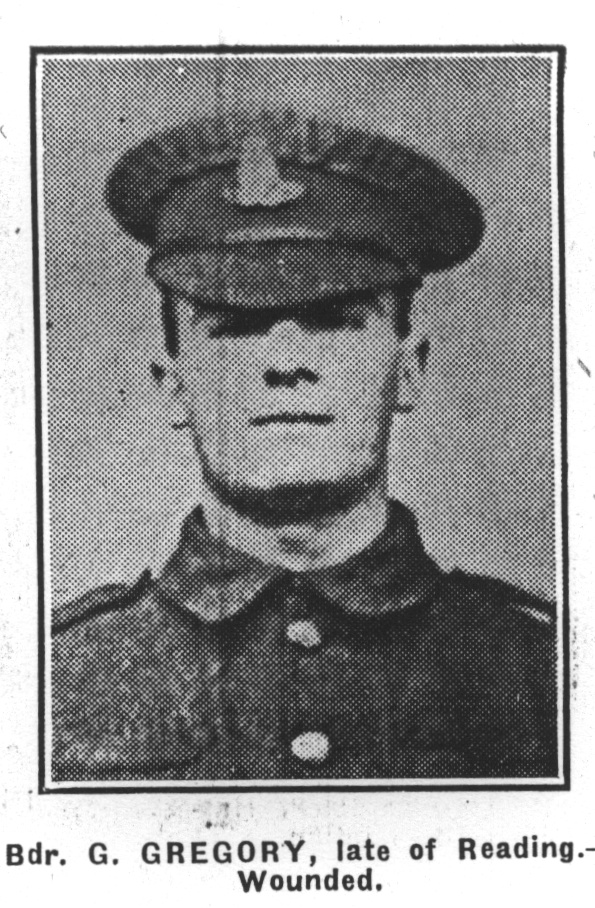
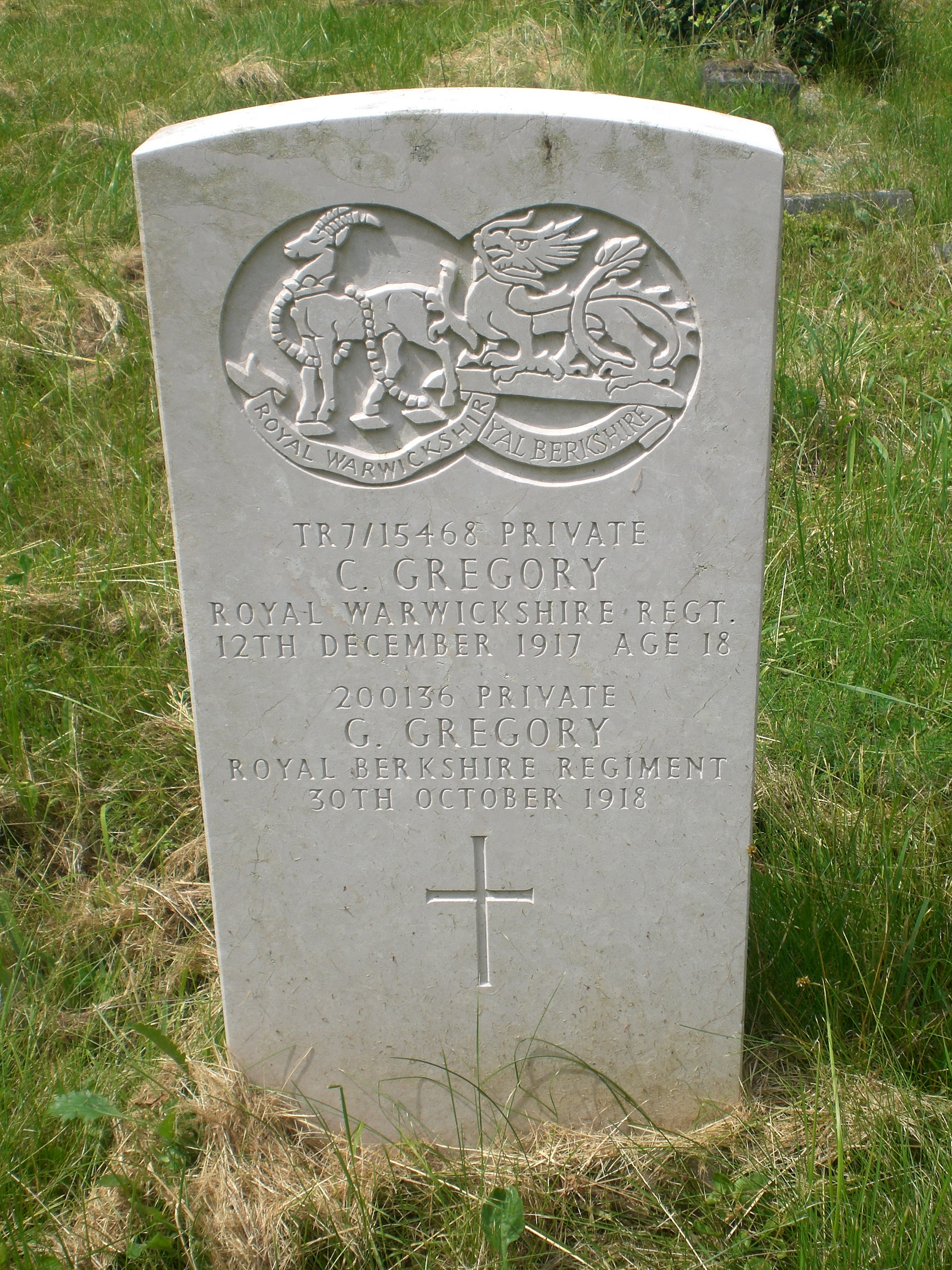
Cecil Gregory and George Gregory

Cecil Gregory
Private 48229
Duke of Cornwall’s Light Infantry (formerly Royal Warwickshire Regiment)

 George Gregory
Private 20001136
Royal Berkshire Regiment

 Division 44


Gregory G photo  CIMG2221


Cecil and George Gregory, were the sons of  Albert and Alice Gregory, of 29 Orchard Street,  Reading.  Theirs is a registered war grave and has a CWGC war pattern headstone, number 3275. 

 Cecil Gregory died of sickness on 12th December, 1917.  Aged 18.  He had been training at Salisbury Plain when he died from pneumonia.

 The Chronicle August 4th 1916 reported that George Gregory had been wounded in his back and right arm and was being treated in Sheffield Hospital. He was 20 years of age.  He died at home on 30th October 1918. He worked at the biscuit factory before the war and was in the Territorials.  The report stated that he once had a very narrow escape after a mine explosion.

 It is not known when he received his injuries or his age at death.  Further research is needed to establish his service battalion.  It is likely that he received his injuries on the Somme.

The 1911 census tells us that Albert Gregory was a labourer at the Biscuit factory. Albert and Alice had been married fifteen years and they had five children. George was the eldest and was a Tin Worker (probably Huntley, Bourne and Stevens). The other children, including Cecil, were in school. In addtion to George and Cecil, Albert and Alice had another son, Alfred and two daughters, Nellie and Doris.

Tom Gray and Fred Gray

Gray bros photo
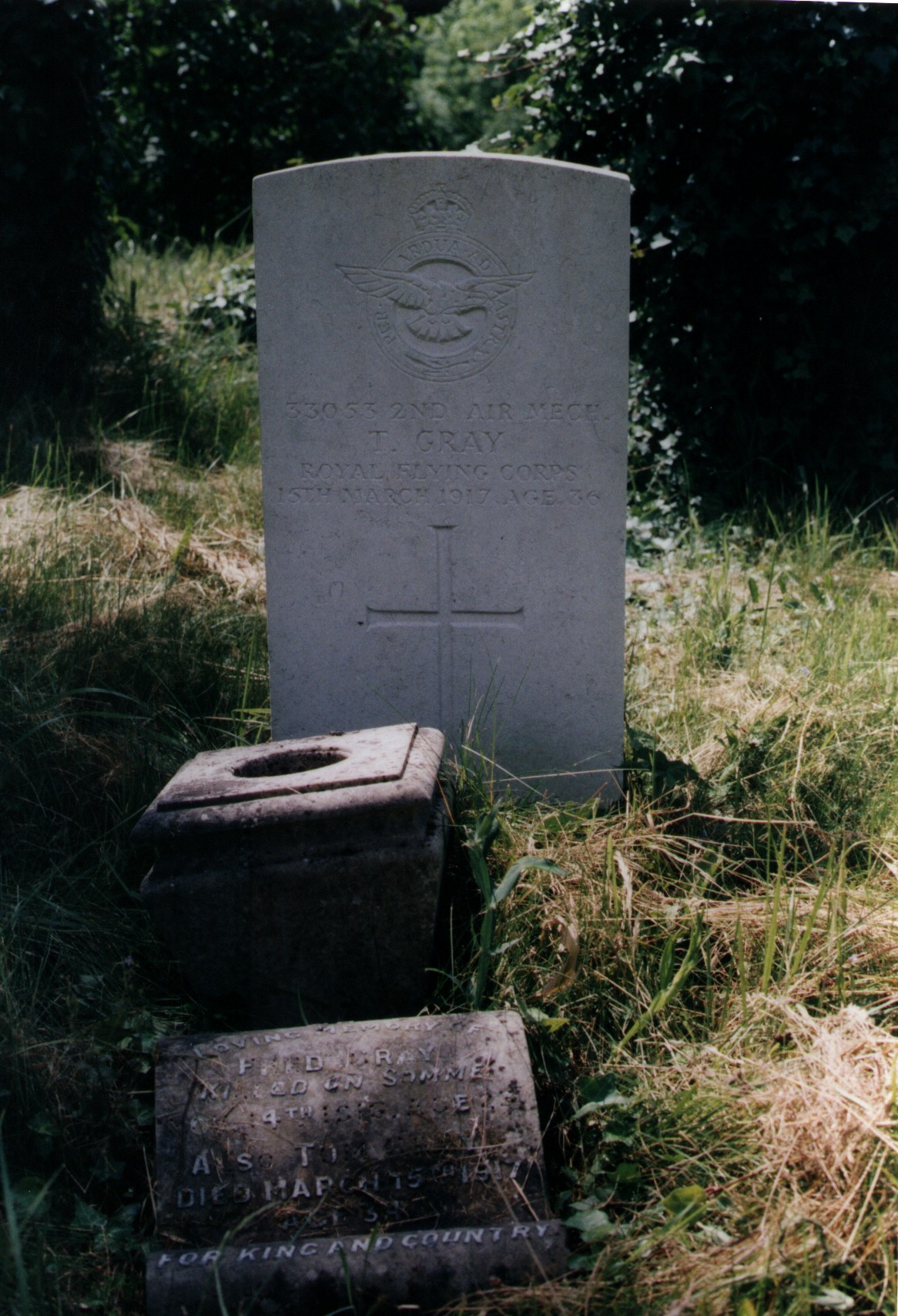
Tom Gray
Air Mechanic II  33053
Royal Flying Corps
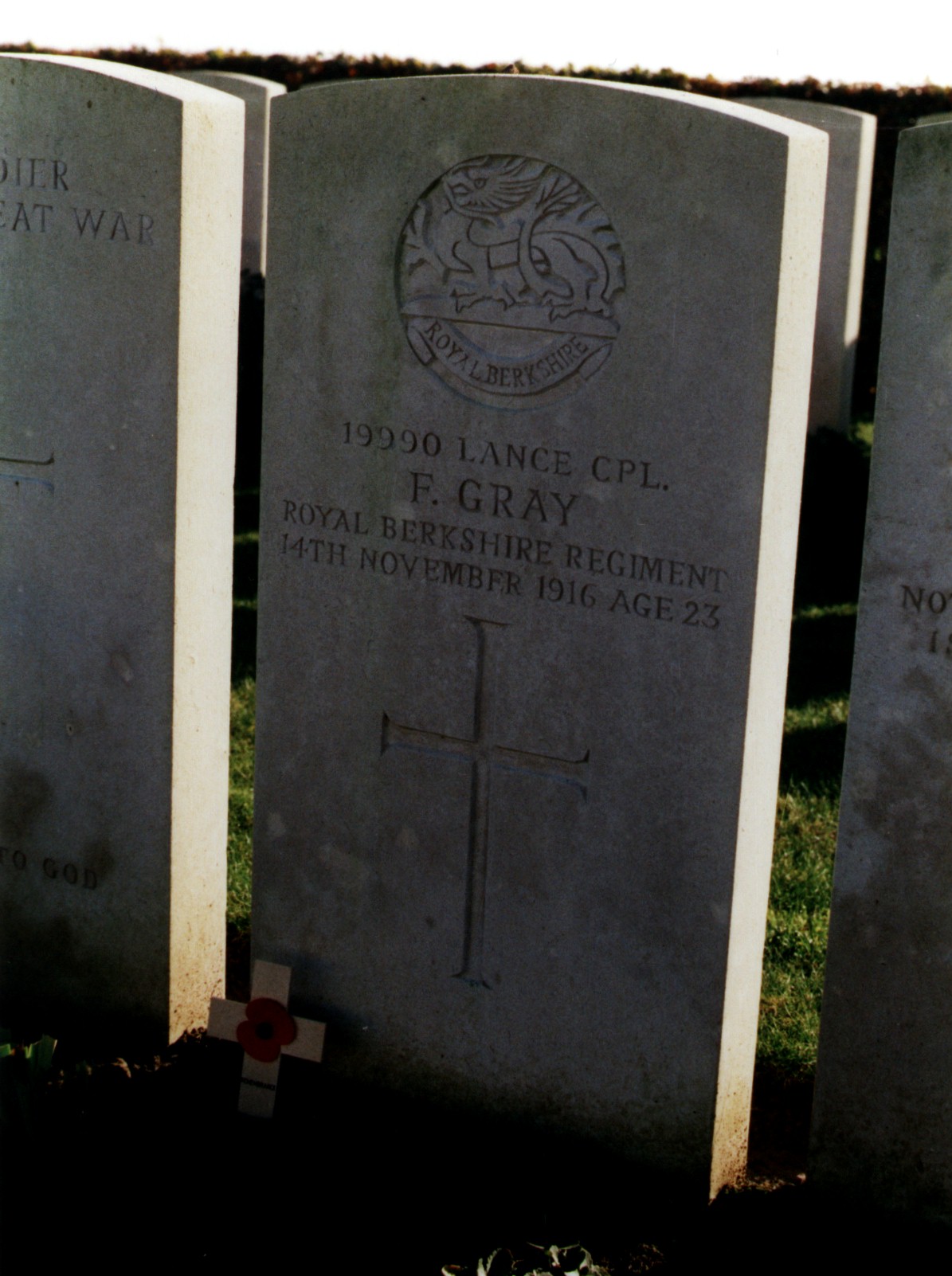
Fred Gray
Lance Corporal 19990
1st Royal Berkshire Regt.

Tom  and Fred Gray were the sons of T. and Elizabeth Gray of 31 Zinzan Street, Reading.

Tom Gray is buried in a registered war grave and commemorated on a CWGC war pattern headstone.  Grave number 3686A.  He died of meningitis, at the time referred to as spotted fever on the 15th March 1917.  Tom Gray was the husband of L. Gray and was aged 33.

TGray grave

Fred Gray is commemorated on his brother grave on a scroll stone.  The inscription states “Killed on Somme”.  Tom is also commemorated on the scroll stone which finished with the words “FOR KING AND COUNTRY”.

Fred was killed by a machine gun whilst taking trenches on November 14th 1916.  The Battle of Ancre, the 4th phase of the Somme battle, had begun the day before and Beaumont-Hamel was captured during the offensive.  The Somme Battle finally came to and end on 18 November 1916.

Fred Gray is buried on the Somme in Munich Trench British Cemetery, Beaumont-Hamel, location B.II.

 FGray grave


 The small cemetery, which holds about 100 graves, was started in January 1917.  Munich Trench was captured on the 11 January 1917 by  V Corps and the cemetery was originally known as V Corps Cemetery No.8.  The burials of those who took part in the last phase of the Somme battle were carried out in the spring.  Although Fred Gray’s body laid out on the battlefield throughout the winter months the ground was not fought over and this enabled the remains to be identified.  Many casualties of the Somme battles were posted as missing and their bodies never found.   Another Reading man, George E. Thatcher is also buried in Munich Trench British Cemetery and a small stone bearing his initials has been found in the Reading Cemetery.