Category Archives: Commemorated name/s

David James Davies

David James Davies
Second Lieutenant
Machine Gun Corps attached to “C” Battalion Tank Corps
.

Division 13

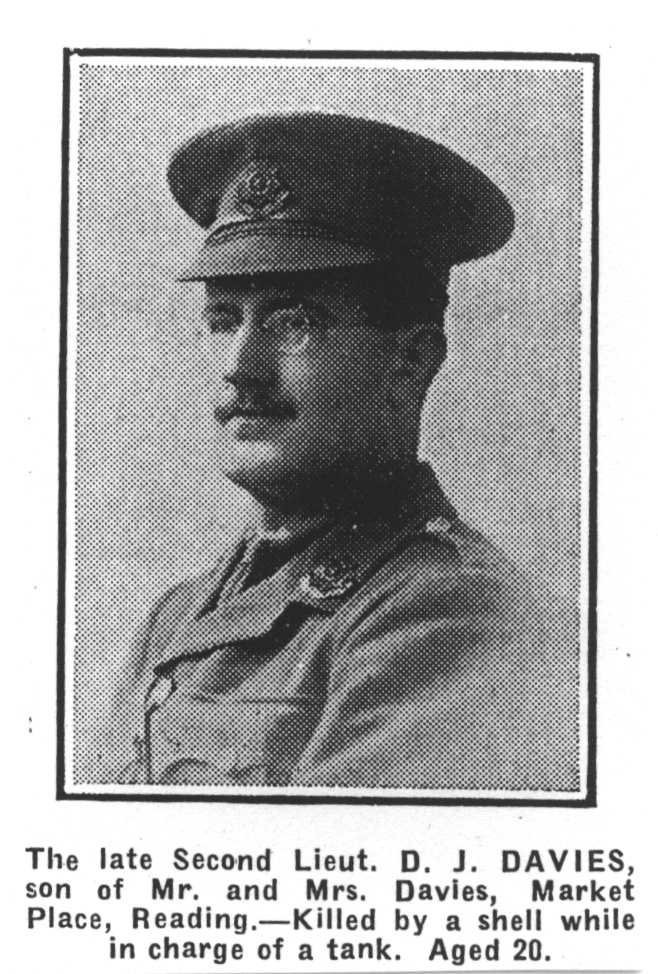
Davies DJ photo

David James Davies was the son of Mr Walter and Mrs Florence Esther Davies of 32. Market Place, Reading.  It was from that address that Walter Davies ran his shop selling china and glass. In 1911 David was 13 and still at school. HIs older sister Ester Madeline is described as working part time in the shop and part time as a student. David’s oldest sister Florence was not living with the family in 1911.  He was commemorated on a his family’s grave. 

 The Third Battle of Ypres began on 31st July 1917.  A bombardment had begun fifteen days earlier and over four million shells had been fired.  (One million had been fired prior to the Battle of the Somme).  At 3.50a.m. the assaulting troops of the Second and Fifth Armies, with a portion of the French First Army lending support on the left, moved forward, accompanied by 136 tanks.  The Tank Corps was only four days old.  Previously it had been known as the Heavy Branch, Machine Gun Corps, a name adopted for purposes of secrecy at their formation.  Preparations for the battle had taken place in dry weather but on the first day the weather broke and three-quarters of an inch (21.7mm) of rain soaked the battlefield.  Men and tanks moved forward behind the creeping barrage over ground churned and cratered by years of shelling.  The surface was softened by the rain but, for all that only two tanks bogged down at the commencement of battle although many ditched later.  A map was prepared by Major Fuller, Staff Intelligence Officer of the Tanks, of the ground over which the tanks were expected to attack.   Where he expected the ground to be marshy, he coloured the area blue.  What he saw appalled him, it was three-quarters of the battlefield.  He sent the maps to Haig’s GHQ so that the Commander in Chief could judge conditions for himself.  However, the map was intercepted by Charteris who refused to show it to the Commander in Chief on the grounds that it would depress him.  Only 48% of the tanks reached their first objective.  Although there was some progress in the early part of the day by late morning the familiar breakdown in communications between infantry and guns occurred.  At two in the afternoon the Germans began to counter attack with a heavy shelling and this together with the heavy rain turned the battle field into soupy mud.  A halt to the offensive was called until the 4th August.  However, Haig insisted that the attack had been “highly satisfactory and the losses slight”.  By comparison with the Somme, when 20,000 men had died on the opening day, only about 8,800 men were reported dead or missing.  The total wounded, including those of the French Army, numbered 35,000, the Germans suffered a similar number.  However, the Germans remained in command of the vital ground and committed none of their counter attack divisions.  Prince Rupprecht , in his diary recorded that he was “very satisfied with the results”.

 It is not known exactly when and where David James Davies was killed in command of his tank but it was struck by a shell on the opening day of the battle.  David Davies had no known grave and his name is commemorated on the Menin Gate Memorial, Panel 56.  He was aged 20.
Arthur Frederick Cude and Albert Stanley Cude

Arthur Frederick Cude
Private 2929
1st/4th Battalion Royal Berkshire Regiment

Division 21

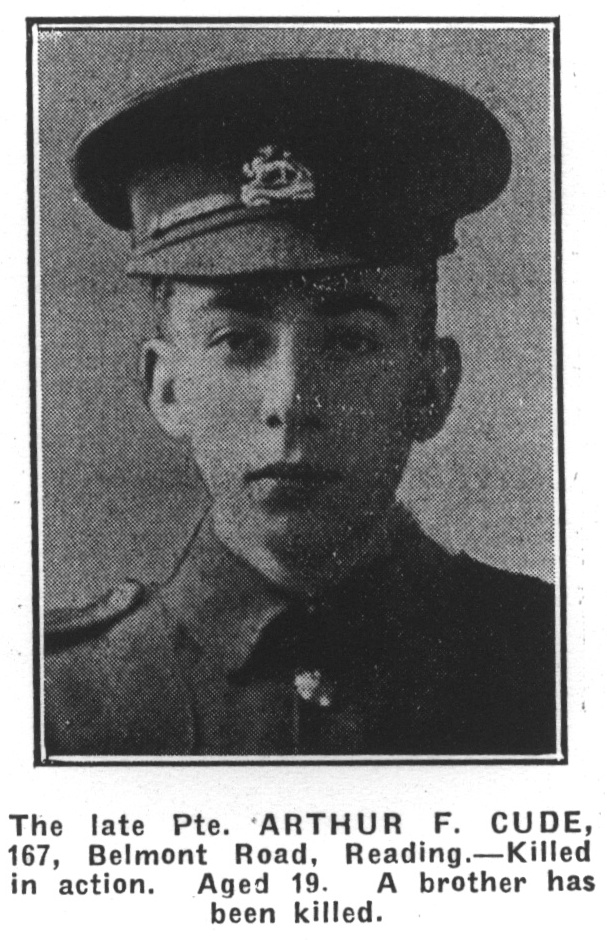
Cude AC photo  CIMG2001


Arthur Frederick Cude  was the son of Mrs. Ellen Cude, of 142, Wilson Road,  Reading.  He was killed in action on the 16th May1916, aged 19. It is believed that Arthur Cude lost his life in the attack set out below:

“In May, the 1st/4th’s took over “G” sector, an area of unfamiliar and difficult ground near Tourvent farm on the outskirts of Serre.  The ground was badly cut up with old trenches and shell holes and littered with bones from the fighting in June 1915.  The communications trench was 1½ miles long and in a very poor state.  Rations had to be brought up from Hébuterne.  The front line was itself a salient which projected towards the strong German defence system around Serre.  The line was defended with some difficulty using an arrangement of disconnected outposts.  At 12.30 a.m. on the morning of 16th May a raid took place.  The Germans had opened a violent bombardment on another sector around midnight on the left of the 48th Division.  The guns of the 48th division responded to a false SOS and the Germans, after registering on the division guns, then directed heavy fire at the batteries.  Across a frontage of 600 yards two platoons of the 1st/4th’s manned seven detached posts.  The bombardment lasted half an hour and was directed at the front and supervision lines.  At 1 a.m. the bombardment shifted to the support and reserve trenches with shells falling at a rate of a hundred per minute.  “B” company in their outposts were over powered and half a supporting platoon of “A” company were destroyed in the bombardment.  When the Germans finally made their attack the outposts were in such disarray that they managed to get in behind and attack the Berkshires from the rear.  The attack, continued by German infantry until 1.40a.m. along different parts of the salient, and the bombardment went on all night until it stopped at dawn.  Losses numbered 98, 18 killed and 29 missing, later most were reported as prisoners of war.  ‘B’ company lost half its fighting strength. This was the first serious test for the 1st/4th’s and their endurance, discipline and fighting spirit were praised by the Divisional and Corps Commanders”. 

(From Petre Official HistoryVolume III)

Arthur Cude is buried  Hebuterne Military Cemetery, Pas de Calais, France.  Grave location Plot I Row C 4.


Albert Stanley Cude
Corporal 9883
10th  Battalion Hampshire Regiment


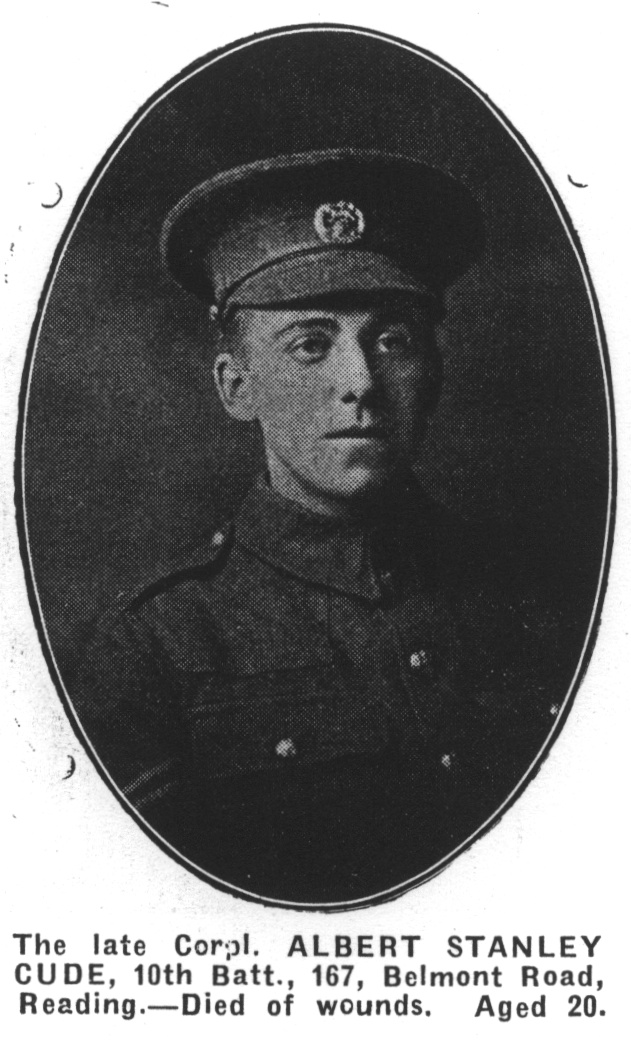
Cude AS photo dbImage[1]

Albert Stanley Cude was the son of Mrs. Ellen Cude, of 142, Wilson Road,  Reading.  He died of wounds on 12th August 1915, aged 20.  Albert Cude is commemorated on the Helles Memorial, Turkey.  Panels 125-134 or 223-226, 228-229 7 328.

 The Helles Memorial stand on the tip of the Gallipoli Peninsula.  It takes the form of an obelisk over 30 meters high that can be seen by shipping passing through the Dardanelles.  It carries over 20,000 names of those who died during the Gallipoli campaign whose graves are unknown or who were lost or buried at sea in Gallipoli waters. 

 The British had successfully landed at Sulva Bay on the 6th August 1915, ready to attack with the Anzac force.  In the very hot weather an attack took place the following day and further attacks took place over the following five days with very heavy losses.   It is not known how Albert Cude was wounded or whether he died of wounds and his body was lost, or  he was buried and his grave lost, or if he died whilst being evacuated and was buried at sea.

The brothers are commemorated on the grave of their parents in the Old Reading Cemetery.  Stanley is remembered on the Blue Coat School Memorial.

Cyril Wilson Cox

Cyril Wilson Cox
Private 3148
1st/4th Royal Berkshire Regiment

 Division 66
Extension

Cox CW photo

Cyril Wilson Cox lived with his mother at 3. Prince of Wales Avenue, Reading. He had been born in Gamlingay, Cambridgeshire and was educated at Newbury Grammar School.  Before the war Cyril Cox worked for Messes. Nicholas Estate Agents, Station Road, Reading.  We are told that  his colleagues held him in high esteem. 

He enlisted on 4th October 1914 and was killed in action seventeen months later on 14th August 1916.  He is named on the kerbs of the family grave and commemorated on the Thiepval Memorial to the Missing, Pier and Face 11D, having no known grave. 

The following is a description from the official history of the action in which Cyril Cox lost his life:

 Around the time of his death his battalion was stationed near to the 5th battalion Royal Berkshire Regt., who on the night of the 12th August 1916 took the enemy by surprise and seized “Ridge Trench” on the crest of a hill which was part of the Thiepval ridge.   On the morning of the 13th August the 5th Battalion were relieved by the 4th Oxfords with the 1st/4th’s in support.  At 9.30p.m. the Oxfords gave notice that the Germans were trying to bomb them out of the trench.  Two platoons from the Berkshire battalion, numbers1 and 2, were sent forward to supply the Oxfords with bombs.  “D” company was put under the command of the Oxfords Colonel with a further supply of bombs.  The Oxfords were due to lead a counter attack but it was the 1st/4th’s who were eventually given the command to lead.  In a manner typical in the chaos of the war, a barrage planned for before the attack did not take place and later, without detailed orders, the Berkshire men tried to cross the 250 yards of open ground facing the Germans.  The Germans, relatively safe and protected in their trenches, were able to shoot unhindered on the advancing lines of men.  The image is one frequently painted during the Great War.  For the survivors of the attack, shelter was poor but fortunately a British aeroplane responded to signal flares and as a result British artillery opened up on the German trenches and the remaining Berkshire men were able to get to safety.  Losses for this flawed action were very high, 140 casualties from the ranks including 59 killed and missing.  Petre in his history of the regiment, comments in his account that, “Failure is often more heroic than success, and these loyal men fought and died with great honour”. 

 The Reading Standard 23rd September 1916 published an extract of a letter sent by a friend to his mother about his death. 

“ It is my sad duty to inform you that Cyril’s death occurred on the morning of August 14th when our company attacked.  Almost immediately he was wounded by a bullet which affected his spine and paralysed him from the waist downwards.  He lived about two hours and was able to have the wound dressed.  From the first I think he knew his end had come.  He passed away repeating his prayers.  Words fail to express what I feel about his death.  It seems hard that a life of such promise should have ended so suddenly, but his destiny as well as ours is in the best hands.”